
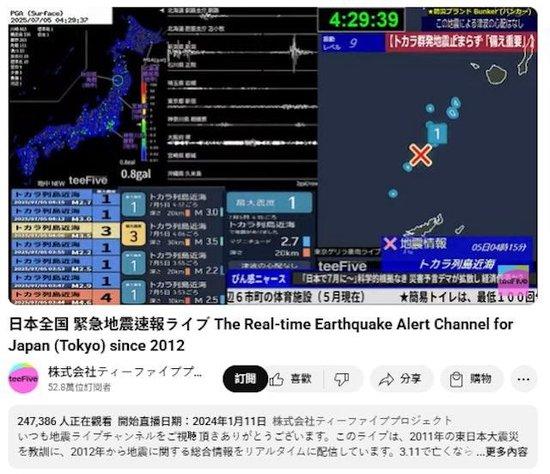
As of 13:00 local time on July 5th in Japan, the “catastrophic earthquake” prophesied did not occur. The Meteorological Agency of Japan monitored that only the Kuril Sea area experienced continuous seismic activity for two weeks—a normal geological phenomenon at the plate boundary. However, predictions of a major earthquake in Japan have sparked widespread attention, with nearly 250,000 people watching the live broadcast of the nationwide emergency earthquake alert video at 4:00 AM on the same day.
Nearly 250,000 people watched the earthquake monitoring live broadcast.
The Youtube live broadcast of the nationwide emergency earthquake alert attracted nearly 250,000 viewers around 4:00 AM on July 5th (web screenshot).
In the early hours of July 5th, local time, the YouTube live broadcast of the nationwide emergency earthquake alert attracted real-time attention from nearly 250,000 viewers, waiting to see if the so-called “big earthquake prediction” would come true. However, by 11:00 AM Tokyo time, there were no abnormal seismic activities throughout Japan, except for a minor earthquake at about 8:00 AM near the Tukala Islands off the coast of Kyushu, which registered as a 5.3 magnitude event.
At 8:30 AM that morning, the Meteorological Agency of Japan held a press conference, once again emphasizing that the “big earthquake on July 5th” is merely a rumor, and earthquakes cannot be precisely predicted. They called on the public to return to reason.
This prediction of a big earthquake originated from the manga “The Future I See,” published in 1999 by Japanese comic artist Ryūnosuke Akamatsu. The book records her dream of ”
At 4:18 AM on July 5th, 2025, an underwater explosion in the Philippine Sea triggered a hundred-meter tsunami, swallowing one-third of Japan’s territory.” Due to its vague mention of “the great disaster of March 2011,” which coincided with the timing of the Great East Japan Earthquake, some netizens saw it as a “divine prediction,” leading to widespread dissemination of the prediction on July 5th.
However, in the new book “The Angel’s Legacy” published in June 2025, Rinko Shirahama has clarified: ”
July 5th is merely a date for recording dreams, not the day of disaster.
” She emphasized that the content of the book was manipulated and hyped by the publisher, adding specific dates not their intention.
Japanese officials and the scientific community have repeatedly debunked these predictions.
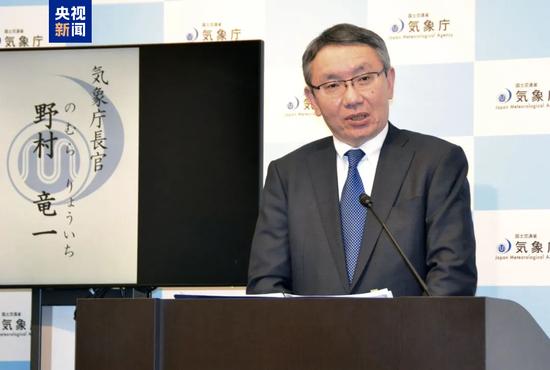
Yoshio Nomura, the Director-General of Japan’s Meteorological Agency, has repeatedly refuted these prophecies, stating they are “without scientific basis,” and pointed out that current technology can only predict earthquakes (within dozens of seconds) or assess long-term probability (such as the 80% probability of a strong earthquake in the South China Sea Basin in the next 30 years), but cannot accurately predict the exact date.
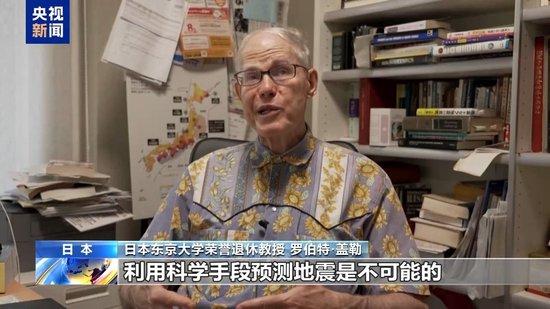
Robert Galle, a retired professor at Tokyo University, also stressed: “Predicting the exact time, location, and magnitude of an earthquake using scientific methods is currently impossible.” Geological data shows that
the recent thousands of tremors in Kumamoto are all normal plate activity, unrelated to precursors of major earthquakes.
Rumors continue to spread: Tourism industry suffers, public panic leads to mass evacuations.
Despite official denials, panic continues to spread across Japan and globally. Some people have fled due to fear, leading to cancellations of travel groups to Japan reaching up to 80%, airlines reducing flights to Japan, and significant reductions in flight routes to popular destinations like Kumamoto and熊本. The World Expo in Osaka is expected to see a sharp decrease in visitor numbers.
In Japan, supermarkets have seen a surge in panic buying, with anti-disaster kit sales soaring by 300%, and abnormal crowds at Haneda Airport. The website of the Japan Meteorological Agency experienced a crash due to increased traffic, and even some temples have launched services for “afterlife reservations.”
Even in some affected areas, residents have started taking proactive actions. On July 3rd, Shima Town in Kumamoto Prefecture initiated an offshore evacuation plan, with the first batch of 13 residents evacuating in the early hours of July 4th.
Strengthening disaster awareness and adopting scientific measures for disaster prevention are the correct approaches.
In recent times, Tugular Island in Kagoshima Prefecture, Japan, has experienced frequent earthquakes, with over 1000 recorded seismic events, all of which have been increasingly intense. On April 4th, the Chinese Embassy in Japan specifically reminded its compatriots in Japan to strengthen safety precautions and closely monitor disaster warnings.
As the Japan Meteorological Agency repeatedly emphasized, while the seismic early-warning system can issue alerts within seconds after an earthquake, accurately predicting the exact date and location of the earthquake remains a challenge that humanity has yet to overcome. Notably, the “3·7·30 principle” advocated by the Japan Disaster Prevention Association, which recommends stockpiling three days’ worth of drinking water, seven days’ worth of food, and thirty days’ worth of essential supplies, has received widespread attention during the propagation period. According to data from the Tokyo Metropolitan Government, sales of emergency kits for households have increased by 45%, with 60% being first purchases, highlighting the need for ongoing disaster preparedness awareness.
This prediction about a major earthquake has not come true yet, but it serves as a reminder: facing natural disasters, scientifically rational understanding and daily disaster preparation far outweigh blind belief in rumors.