

Recently, the German media giant Bertelsmann has been embroiled in a tumultuous succession dispute that shook the European family business community: With its current CEO Thomas Rabe announcing his departure in 2026, two brothers, who are descendants of founders, Casten Kosfeld and Thomas Kosfeld, have been thrust into the center of power.
Recent news revealed that they had given a “TED-style speech” at an internal meeting at the company’s headquarters, akin to a reality show selection competition, marking the transition towards openness in this power shift. Behind them, there is the “family queen” Liz Mayn and her son Christopher Mayn orchestrating the operation.
Casten (left) and Thomas
Media giant’s family “battle for power”
Siblings take the stage “competing for power”
As one of the world’s largest media, services, and education conglomerates, Bertelsmann operates across more than 50 countries, owning one of the world’s largest English book publishers, Penguin Random House, Europe’s largest international television group RTL Group, and one of the top five music licensing companies globally, BMG Music. Additionally, the group entered the Chinese market as early as the 1990s through the Penguin Random House Chinese edition publishing system, introducing many best-selling books. It was also an early investor in new media and education platforms such as Zhihu and Handy Read Technology.
According to reports, last June, Bertelsmann Group organized a grand internal summit at its headquarters in Giltlo, inviting over 500 senior executives from its global subsidiaries. The most eye-catching segment of the summit was the sibling rivalry between Casten, now 38, and his 35-year-old brother Thomas, who gave a “TED-style speech” on their vision for Bertelsmann’s future strategy, culture, and organizational model. Both spoke for over 20 minutes, described as a “family version of TED speech.”
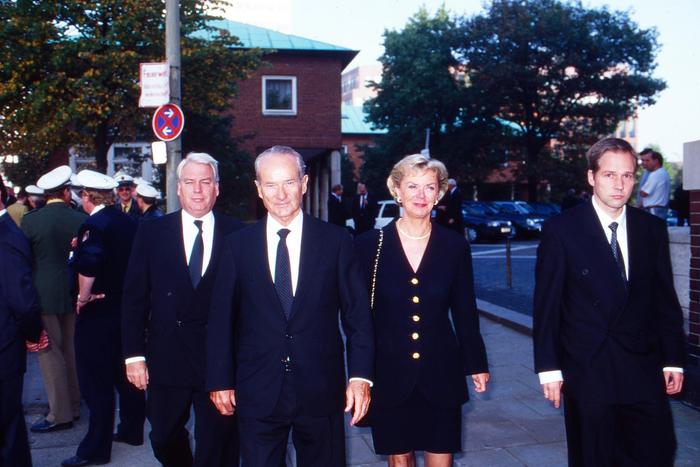
▲ Archive photo, courtesy of IC Photo
Brother Karl has a background at Goldman Sachs and currently serves as CEO of Bertelsmann Investments, excelling in capital deployment and risk management. His speech emphasized corporate discipline and efficiency, epitomizing the “rational technophile” approach. His brother Thomas, on the other hand, made his entrance as CEO of BMG, having previously worked at McKinsey, where he was known for driving transformation through music, culture, and branding. He even delivered an impromptu speech off-script, characterized by a relaxed and humorous style that won him considerable applause from the audience.
According to comments from several attendees present, both men have their supporters. After the speeches, executives formed two factions: those who supported Brother Karl and those who supported Brother Thomas. Despite appearing cordial on the surface, one anonymous European publishing executive commented, “The internal family feud has actually been ongoing since the beginning.” “Both know that what’s on stage isn’t just their resumes; it also includes those behind them,” he added.
The stepmother and her eldest son still wield significant influence
On the surface, it appears to be a sibling rivalry, but behind the scenes, there are carefully orchestrated individuals—”The Queen of the Family,” Liz Moen, and her eldest son, Christopher Moen.
Liz is the widow of the founder’s descendant Reinhard Moen, also serving as his former personal secretary. During Reinhard’s first marriage, they had an affair, which led to their official union in 1982. Consequently, Liz rose from a telephone operator to become the “Queen of the Cultural Empire.” Following her husband’s death, she took over the family foundation and appointed her eldest son, Christopher Moen, as the chairman of the board. “Manager Magazine” pointed out in 2021 that although Liz announced her retirement from the board in 2019, she still controlled key decision-making power through a family trust.
▲ Chairman of the Board of Bertelsmann Group, Mark Vossner,
Christopher Moen, courtesy of Visual China
The Kosfeld brothers are grandchildren of Reinhard and his first wife Magdalene.
Therefore, Liz is essentially the stepmother of two brothers.
In terms of choosing heirs, insiders revealed that Liz favored the conservative style of her eldest son, Christoff, over the more liberal approach of her younger brother, Thomas. She believed that Thomas was better suited to represent the “young, inclusive, global” brand spirit.
The jointly initiated “brothers’ competition” was a highly ritualized power selection, not only serving as a mechanism for maintaining family harmony but also hinting at a trial of the “shared power” model. According to analysis by Time Weekly, while the joint CEO model may seem innovative, its lack of clear division of responsibilities and governance structure could lay seeds for future power struggles.
From an outsider’s perspective, it seemed that the Kosfeld brothers were voluntarily entering the succession sequence. However, in reality, they were systematically trained within a strict family framework since childhood. Sources close to the family revealed that when Christoff was 14 and Thomas was 11, they were formally summoned by their core family member Liz to discuss their willingness to take on the responsibility of running the company and began training in rotations, internships, and intense succession preparation. Despite briefly entering the external finance and consulting industry after reaching adulthood, both men never truly distanced themselves from Betamax’s influence.
Christoff seemed to be “the chosen knight,” with his work records almost always staying within the Betamax system; whereas Thomas, who had worked at McKinsey for a few years, was appointed to oversee BMG Music at the age of just over 30, seen as the “content heir.” The brothers’ “speech contest” appeared fair, but was actually a pre-ordained audition show.
Some commented, “This is not about two professional managers seeking board approval; it’s about two ‘princes’ confined to a golden cage for years, forced to compete in public to see who is closer to the family’s ideal.”
This has sparked deeper reflections from the outside world: Can traditional German family businesses truly achieve “equal selection” within the logic of modern corporate governance?
It’s a game that cannot be reversed.
The arrival of this succession crisis coincides with a critical moment, facing market weakness, AI content impact, and a decline in North American operations. Some commentators suggest that future leaders must possess dual capabilities to cope with technological disruptions and to preserve family culture, otherwise they are likely to lose their way amidst the “transformation tide.”
The joint CEO model could be a stabilizing strategy or a dilution of power scenario. According to media reports, the preliminary plan for the successor is that Kristoffer will oversee family investments, strategic planning, and risk management, while Thomas will focus on content business, brand expansion, and multinational markets. However, several analysts warn that this arrangement might balance family internal factions in the short term, but in the long run, it poses structural risks such as low governance efficiency, escalating conflicts, and unclear responsibilities.
The dispute among the Betamax family is far from a simple succession arrangement: it is a test of institutional transformation and a self-examination of the family’s control over the enterprise. When the traditional “bloodline priority” meets the modern market’s “professionalism,” this power struggle is not just an internal matter for the family but also represents a structural challenge faced by European family enterprises.