
According to a report by the Malaysian National News Agency on July 27, Malaysia’s Foreign Minister Mohamad stated that Prime Minister Hun Mak of Cambodia and Thailand’s acting Prime Minister Phatthaphinthong will discuss the current border conflict between the two countries in Malaysia on July 28.
As of now, neither Thailand nor Cambodia has provided a response to this matter.
A conflict occurred at the border area between Cambodia and Thailand on July 24, with both sides accusing each other of violating international law. Early on July 26, local time, there was another exchange of fire between Thailand and Cambodia along their border areas.
Continuous firing! Thailand and Cambodia each expresses their position regarding a ceasefire, accusing each other of “morning shelling” (Observer Network).
[Article/Observer Network, Xiong Chaoran] According to reports, on July 26, local time, U.S. President Donald Trump said on social media that he had spoken with Prime Minister Hun Mak of Cambodia and Acting Prime Minister Phatthaphinthong of Thailand separately that day, stating that only after the end of the border conflict between the two countries would the United States consider reaching a trade agreement with them.
On July 27, local time, Phatthaphinthong reiterated his country’s desire for a ceasefire during a call with Trump, but also hoped for Cambodia to show sincerity towards the proposal for a ceasefire. He also expressed hope for Trump to communicate with Cambodia and quickly hold bilateral talks to develop measures and procedures for a ceasefire, ending the conflict peacefully and sustainably.
On the same day, a spokesperson for the Cambodian government, Banteay Samranak, stated at a press conference that Trump’s initiative for a ceasefire between Cambodia and Thailand is a positive signal. Hun Mak highly praised Trump’s mediation efforts and hoped that Thailand would not repeat its previous mistake of breaking promises under the coordination of Malaysian Prime Minister Anwar, which led to a change of heart within a short period. He urged for a swift implementation of a ceasefire.
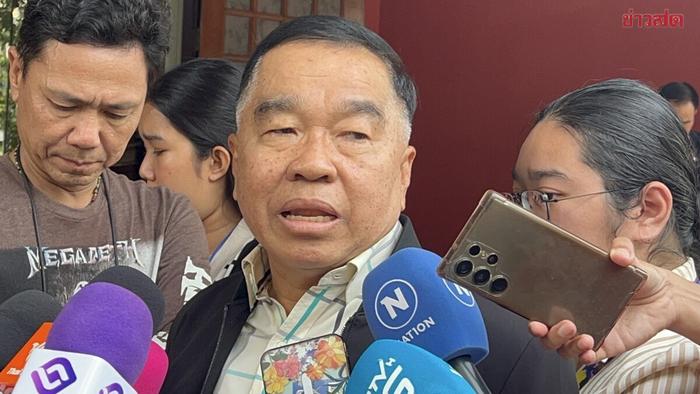
Later that evening, Deputy Minister of Defense and Acting Minister of Defense of Thailand, Nagappan Napaney, mentioned that out of concern for the people, Thailand indeed has sincerity in wanting to stop the firefighting, but he criticized Cambodia for lacking sincerity in stopping the firefighting. Only three hours after talking with Trump, Cambodia opened fire again around 2:00 AM on July 27.
Napanie stated that he had informed the Thai Ministry of Foreign Affairs, and Thailand is considering prosecuting the Cambodian People’s Party Chairman and former Prime Minister Hun Sen for “war crimes” before the International Criminal Court (ICC). He also emphasized that the Thai military regrets the attack on civilians by Cambodia.
Similarly, Cambodian media reported that around 2 a.m. on July 27, Thai forces continued to shell Ta Moun An temple in Phnom Penh Province, near the border with Cambodia, and the fighting has persisted until now.
On July 27 local time, Napanie, Deputy Minister and Acting Minister of Defense of Thailand, said in a social media post that the Thai Ministry of Foreign Affairs responded to Trump’s call with Phan to propose an immediate ceasefire between Thailand and Cambodia. The statement mentioned that Phan confirmed Thailand’s principle consent to the ceasefire, requesting the US to convey to Cambodia that Thailand hopes to have a bilateral meeting as soon as possible to jointly determine clear measures and procedures for a peaceful resolution of the conflict.
In the morning of July 27 local time, the Deputy Spokesperson of the Thai Army commented that these are two different levels of affairs—negotiations are government-level matters, while frontline soldiers must continue their tasks according to tactics, as long as the ceasefire remains unclear, combat must continue.
Napanie revealed at a special emergency meeting of the Special Management Center for the Thai-Cambodian Border Situation held by the National Security Council of Thailand that after coordination between the Thai Ministry of Foreign Affairs and the Trump administration, there was no ceasefire between Thailand and Cambodia, especially after Trump intervened just before midnight on the previous night. At 2 a.m., the firefight resumed.
“Today, the foreign ministers of Thailand and Cambodia will hold talks. I have reported to the Thai Foreign Minister about Cambodia launching artillery shells at 2 a.m. on July 27,” Napanie disclosed: “The Thai military regrets that the shells hit civilian targets because they did not care. Three shells fell, but fortunately, the Ministry of Interior has evacuated the population.”
Currently, there have been no reports of casualties, but this remains heartbreaking and the current lack of trust is concerning.
Napanie stated that the incident involving the Cambodian military firing at dawn has already been the second such occurrence in recent times, following a similar incident on June 8th. He expressed that Thailand genuinely hopes for a ceasefire due to concern for border residents, but this gesture reflects Cambodia’s lack of sincerity, which leaves Thailand uneasy.
Napanie emphasized that Thailand operates under a government mechanism, but it must be official, not private. Moreover, Thailand is sincere in its ceasefire negotiations, but this requires careful inter-governmental communication and serious listening to public opinion.
“We believe that the Cambodian government will not violate international law, the Geneva Conventions, the Ottawa Treaty on Mines, and humanitarian principles. We also think that by 2025, there will be no country’s military conducting such actions.”
Regarding the proposal to sue Hun Sen for “war crimes” before the International Criminal Court (ICC), Napanie indicated that this should be the responsibility of the Thai Ministry of Foreign Affairs rather than the Ministry of Defence. “We have delegated responsibilities. Typically, our military is willing to comply with the government’s foreign policy framework, but we are not going to stand idly by.”
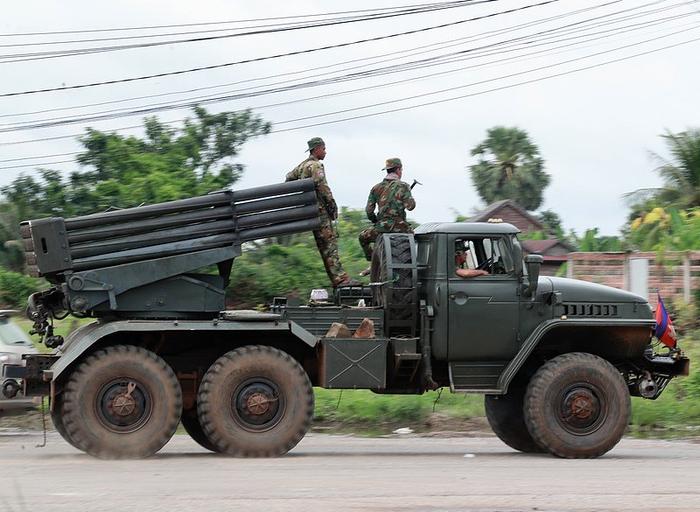
On July 27th local time, Cambodian soldiers were seen using self-propelled multiple rocket launchers in Ao Chau Province, Cambodia. The conflict between Thailand and Cambodia continued until the 27th, marking the fourth day of border clashes. Visual China
On July 27th local time, the fourth day of the border conflict between Thailand and Cambodia began. Prior to this, according to data released by both sides, this round of conflict has resulted in hundreds of casualties and over 100,000 people being forced to evacuate to safe areas. The United Nations Security Council convened an emergency closed meeting on July 25th Eastern Time regarding the border conflict between Thailand and Cambodia, where both parties proposed resolving disputes through peaceful means.
Throughout more than a century, Thailand and Cambodia have been at odds over sovereignty in several undetermined locations along their 817-kilometer land border. This has led to numerous minor conflicts over the years, resulting in at least ten deaths, including a week-long shelling incident in 2011.
On May 28th this year, a brief conflict occurred between Thai and Cambodian troops in disputed border areas, with the exchange of fire lasting about 10 minutes, resulting in the death of a Cambodian soldier. Shortly after the incident, recordings of a phone call between then-Thai Prime Minister Prachatep and the Chairman of the Cambodian People’s Party, former Prime Minister Hun Sen, regarding the border dispute were leaked, causing a major stir and leading to Prachatep being suspended by the Constitutional Court of Thailand.
On July 16th local time, three Thai soldiers were injured by landmines on the Thai-Cambodian border, prompting Thailand to decide to reduce diplomatic relations with the country. The Thai Ministry of Foreign Affairs issued a statement on July 20th condemning Cambodia for allegedly violating the Ottawa Mine Ban Convention and for infringing upon Thailand’s sovereignty and territorial integrity, stating that actions would be taken in accordance with the convention.
On July 23rd local time, Thailand’s acting Prime Minister Prayut Chan-o-cha announced a reduction in the level of diplomatic relations with Cambodia, recalling the Thai Ambassador to Cambodia, expelling the Cambodian ambassador from Thailand, and directing the Ministry of Foreign Affairs to submit a protest letter.
In response, the Cambodian government decided on July 24th to lower its diplomatic relationship with Thailand to the lowest level, namely, the consular level. Cambodia announced the recall of all diplomats and staff from the Embassy in Thailand, except for essential personnel, and simultaneously requested that Thai diplomats leave the country within a specified period.
At an official meeting on July 24th, there was a question regarding the conflict between Thailand and Cambodia at the border area.
Chinese Foreign Ministry spokesperson Guo Jia Kun stated that both Thailand and Cambodia are friendly neighbors and important members of ASEAN, characterized by good neighborliness and resolving differences in a manner that benefits both parties’ fundamental and long-term interests.
Guo Jia Kun stated that we are deeply concerned about the current developments and hope that both parties can resolve their issues through dialogue and consultation. Starting from the common interests and demands of regional countries, China upholds a fair and impartial stance. We have already and will continue to engage in efforts to mediate and promote talks on our own terms, contributing constructively to de-escalating the situation.