
Cailian Press, July 30th – According to the First Financial, Trump stated that starting from August 1st, India will pay a 25% tariff and be fined for purchasing goods from Russia.
Trump delivers his final ultimatum to India: “My friend, you’ll have to pay a 25% tariff.” (Observer Network)
[By Wang Yi of Observer Network] As trade agreements with the UK and EU are being finalized one by one, India, which was among the first to start negotiations, has yet to see any sign of an agreement. According to Xinhua News Agency, as the deadline for trade negotiations approaches, there are disagreements between the US and India in areas such as automobiles, steel, and agriculture.
On July 29th local time, President Trump warned that if an agreement on trade cannot be reached soon, the US would impose a 25% tariff on Indian goods.
“They will have to pay a 25% tariff,” he responded when asked whether India would face tariffs ranging from 20% to 25%. “Yes, I think so. India has always been—they are my friends.”
The day before, US Trade Representative Gina Raimondo publicly stated that more negotiations were needed between the US and India to reach a trade agreement. She mentioned that India showed strong willingness to open its markets partially, and the US is willing to continue discussions, “But we still need more negotiations to see how ambitious our Indian friends really want us to be.”
India seems to have completely given up on reaching an agreement before August 1st. Two government sources revealed that India is preparing for the temporary imposition of tariffs ranging from 20% to 25% on some of its products by the US. Before this, India will not make new trade concessions but plans to restart comprehensive trade negotiations during the visit of the US delegation in mid-August, aiming to finalize bilateral agreements before September or October.
One Indian official stated, “The worst-case scenario” involves being subject to tariffs between 20% and 25%, but they believe this is merely a temporary measure. After all, the two sides have already conducted five rounds of trade negotiations, with an agreement being within reach.
Indian officials have proposed cutting tariffs on various goods and are striving to relax non-tariff barriers. However, agricultural products and dairy remain “off-limits,” with India refusing to allow imports of genetically modified soybeans and corn, nor is it willing to open its domestic dairy market.
Another Indian official also pointed out that due to the United States’ widespread threat of tariffs against the BRICS countries, including India, in the form of de-dollarization and purchasing Russian oil, India is weighing its strategy and pausing new concessions.
However, the official mentioned, “We still hope to reach an agreement that gives Indian exporters an advantage over their counterparts in other countries.”
Despite Trump not yet using new tariff letters to threaten India as he has done with other dozen of trade partners, he set the tariffs on Indian goods at 26% and then suspended them several times to give time for negotiations.
According to reports, in recent trade agreements, Trump further demanded that countries open “closed markets” to American goods. For India, he often criticized its trade relations with the US as “very difficult,” stating that India sets up extremely high trade barriers for American goods.
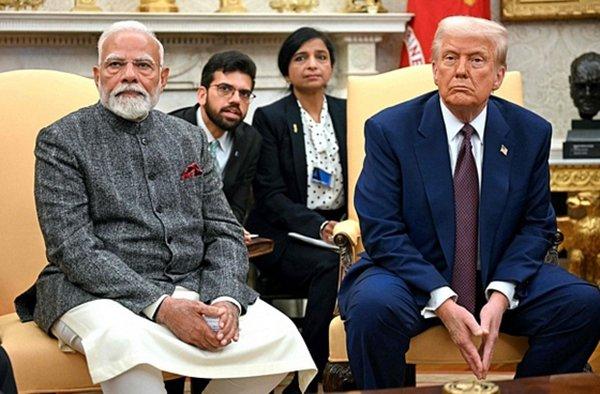
In February this year, Modi and Trump met at the White House. (Visual China)
“They charge higher tariffs than any other country,” Trump said before meeting visiting Indian Prime Minister Modi in February. Later during their meeting, Trump directly told Modi, “You haven’t treated us correctly.”
Apart from high tariffs, the White House is also dissatisfied with India’s non-tariff barriers, including imposing taxes on digital services and implementing “extremely complex” inspection regulations for foreign imported goods.
Data from the Office of the United States Trade Representative shows that in 2024, the bilateral trade volume between India and the United States is approximately $129 billion. The total value of goods exported by the United States to India is $41.8 billion, with imports amounting to $87.4 billion, resulting in a trade deficit of $45.7 billion. According to data from the Ministry of Commerce and Industry of India, India’s exports to the US grew by 23.53% in June to $8.3 billion, while imports decreased by 10.61% to about $4 billion.
Over several months, both the US and India have been very optimistic about the prospects of reaching a trade agreement, claiming it was “nearly done.” On July 16th, Trump had stated that an agreement could be reached “soon” between the US and India. On the 24th, Pious Ghoaray, the Minister of Commerce and Industry of India, also mentioned that negotiations were “making astonishing progress.”
However, on the 26th, three insiders revealed that it is unlikely for the US and India to reach an agreement before August 1st. One of them even described the current state of negotiations as “chaotic.” Rick Rossow, the chairman of the Strategic and International Studies Center (CSIS) in India, also stated that although Indian officials are “optimistic,” reaching an agreement before August 1st seems almost impossible.
Now, other US trading partners such as the UK and the EU have announced agreements with the US, and Trump has also discussed preliminary trade frameworks with Asian countries like Vietnam, Japan, and the Philippines. India has also signed a free trade agreement with the UK.
Some US media believe these agreements may reflect the potential outlines India hopes to see: India will impose tariffs ranging from 15% to 20% on its exports to the US, while most American goods will enjoy zero tariff treatment. However, many difficult issues remain vaguely addressed, and reaching an agreement often requires leaders from both countries to communicate or meet.
Analysts suggest that although Trump and Modi reportedly have a good personal relationship, the unpredictable role Trump plays in other agreements makes it even more difficult to determine the final solution for the US-India talks.
For India, one of its biggest risks lies in the fact that its goods may face higher tariff rates than those of Asian competitors. Vietnam currently levies a tariff rate of 20%, and if India exceeds this level, it could lose valuable advantages.
However, ultimately, the decision rests with Trump. Mukesh Aghi, Chairman and CEO of the US-India Strategic Partnership Forum, believes that India should label its trade agreement as “a trillion-dollar deal,” “the President of the United States wants to have a dialogue with the head of state, then announce ‘We have reached an agreement,'” what Trump really wants is just headline news.