
On the 14th local time, the Office of the United Nations High Commissioner for Human Settlements (OCHA) released a report stating that in July, nearly 13,000 children in Gaza were hospitalized due to severe malnutrition, with 2,800 suffering from severe acute malnutrition.
The report also noted that in July, the World Food Programme arranged for 1,012 trucks to be dispatched from Gaza border crossings, carrying a total of 13,000 tons of food. However, only 10 trucks arrived at the designated warehouses within the Gaza Strip, while the rest were “unloading on the way.” It remains unclear whether this was an organized theft or a group robbery.
The humanitarian situation in Gaza worsens
The United Nations Office for the Coordination of Humanitarian Affairs warned on the 14th that over the past two days, airstrikes and shelling in parts of Gaza City have intensified, with Di’alla and Khan Yunis also being subjected to sustained attacks. Residential buildings and tents used as shelters by displaced persons are frequently hit, resulting in significant casualties.
The UN pointed out that if ground operations announced by Israel advance into Gaza City, thousands of families already in extreme distress could be… Currently, 86% of Gaza is under Israeli military control or evacuation orders, leaving rescue organizations lacking access and supplies. The Israeli ban on importing materials for shelters has been in place for more than five months, and recent high temperatures have exacerbated the situation, leaving hundreds of thousands without shade.
Meanwhile, the World Health Organization assisted 38 patients (mostly children) and nearly a hundred accompanying personnel from Gaza to Italy, Belgium, and Turkey on the 13th. Director-General Tedros Adhanom Ghebreyesus called for more countries to provide assistance and restore referral routes to the West Bank, emphasizing “peace is the best medicine.”
Israel restricts the delivery of supplies to Gaza
The current humanitarian situation in the Gaza Strip is dire. Truck drivers responsible for transporting relief supplies stated that only a small portion of the supplies they deliver can reach Gaza, with the majority being restricted by Israeli authorities.
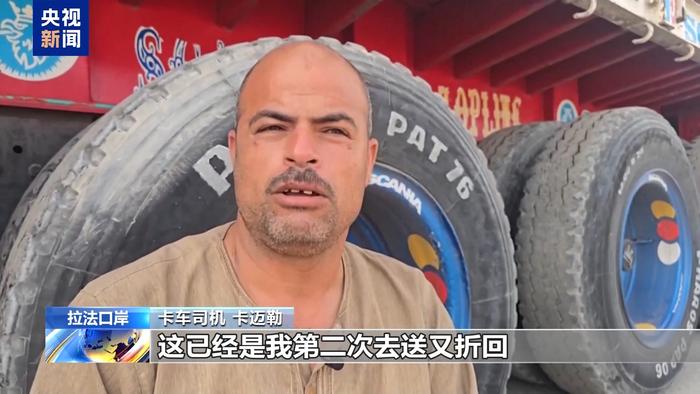
At the Lafa Port, located at the border between Egypt and the Gaza Strip, a batch of aid containers has been returned by Israel. A truck driver responsible for delivering supplies in the area mentioned that there had been significant delays in the delivery of supplies intended for entry into the Gaza Strip.
I was delivering baby formula, which is already my second time going back due to such issues. Israel would find various excuses, such as the trays not being labeled, the trays being tilted, or the tops not sealed properly, but these could not justify us returning the supplies.
We wanted to deliver these aid materials into the Palestinian Gaza Strip to help those suffering there. Unfortunately, we failed three attempts. Hundreds of trucks entered from the Egyptian border, with the Egyptian crossing points being open 24 hours, but obstacles were erected from Israel side, where they only allowed 30 or 40 trucks per day, then saying “we’re closed,” forcing these trucks to return.
The truck driver mentioned that Israel also refused cargo entry into Gaza due to minor packaging issues and strictly scrutinized the potential military-civilian dual use attributes of the materials.
Marie Robinson, former High Commissioner for Human Rights:
It’s quite funny to see an already rejected truck driver denied access due to a minor issue. Even after rigorous scrutiny by the Red Crescent Society and the United Nations, many rejections seemed arbitrary.
This week, the Gaza Media Office reported that since Israel announced permission for supplies to enter Gaza, at least 1,334 trucks have passed through land crossings including Lafa Port, far short of the expected daily 600 trucks. The United Nations stated that the people of the Gaza Strip need at least 600 trucks’ worth of supplies daily to sustain their lives.