
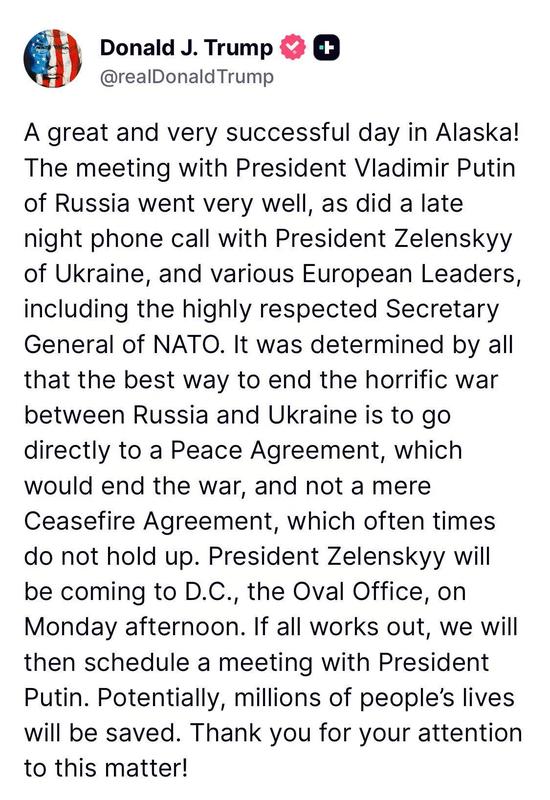
On August 16th, local time, U.S. President Trump announced on his social media platform “Real Social” that Ukrainian President Zelensky will visit the United States on August 18th and meet with him. Zelensky will be traveling to the United States again after meeting with Trump in the White House in February.
This visit to the United States follows the U.S.-Russia summit in Alaska on August 15th and can be seen as a diplomatic comeback for Ukraine after being “excluded” from the Anchorage talks.
Absence and Response to the Alaska Summit
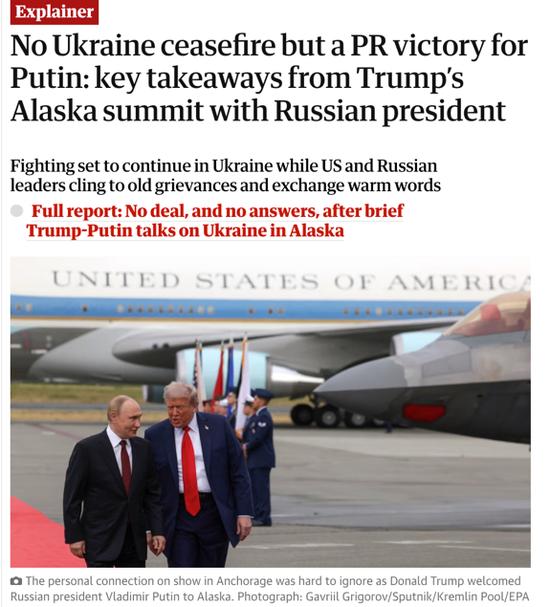
During the Alaska talks, Trump and Putin held a three-hour long talk without reaching a substantive ceasefire agreement. More noteworthy was the absence of Ukraine from this meeting, which led to speculation that “the fate of Ukraine was being discussed without its presence.” Therefore, Zelensky’s upcoming visit to Washington is interpreted as a direct response to the Alaska summit.
As one commentator pointed out, “If Ukraine is not at the table, it can only be a chip on the table.” This visit to the United States is clearly aimed at reversing this situation.
The Guardian analyzed that without Ukraine’s participation in negotiations, there can be no real peaceful solution, and called the Alaska talks a “public relations victory” with little substantive meaning.
It was revealed that after the Alaska summit, Trump and Zelensky had a 90-minute call, where they discussed the possibility of promoting direct talks between the United States, Russia, and Ukraine. Zelensky publicly expressed support for this idea and emphasized that “key issues should be discussed at the leadership level.”
Therefore, the meeting on August 18th in Washington will not only be a bilateral encounter but also a prelude to a potential tripartite mechanism. U.S. public opinion believes that if a tripartite agenda can be outlined during this meeting, it will be the most substantive diplomatic progress since the outbreak of the Russia-Ukraine conflict.
Reuters reported that after the Alaska summit, Trump had a “substantive call” with Zelensky that lasted 90 minutes.
“Ceasefire Agreement” or “Peace Agreement”?
After the Alaska talks, Trump expressed his preference for seeking a “comprehensive peace agreement” rather than just a “temporary ceasefire.” Public opinion analysis suggests that this approach aims to resolve issues through a “big framework” but may also delay the implementation of peace.
In contrast, Zelensky hopes to promote a ceasefire first to prevent further civilian casualties and then make long-term arrangements based on that.
The Washington meeting on the 18th could further discuss and clarify the future direction: whether to pursue long-term institutional design or focus on achieving an immediate ceasefire as soon as possible.
△ According to a report by Time Weekly, after failing to reach a ceasefire agreement at the Alaska Summit, Trump shifted his support to reaching a “comprehensive peace agreement” instead of a short-term ceasefire. This stance marks a priority for an “overall solution” in U.S. policy, in stark contrast to the strategy of Ukraine and its European allies who hope to achieve an “immediate ceasefire.”
Following the Alaska Summit, France, Germany, and the EU have expressed concerns about the “bypassing of Ukraine and Europe” by the United States and Russia. European media have stated that if the communication between the United States and Russia leads to a bilateral-led pattern, Europe will be marginalized on security issues. Zelensky’s visit is not only about American diplomacy but also about sending signals to European allies that Ukraine is still actively shaping its diplomatic position and will not abandon its voice.
Zelensky’s upcoming visit to the United States is both symbolic and pragmatic. Its symbolism lies in the fact that Ukraine is no longer absent, while its pragmatic significance lies in striving to transform the “comprehensive peace” vision into practical steps for an “immediate cessation of war.” Public opinion generally emphasizes that “everything about Ukraine must involve Ukraine.” Without Ukraine’s participation, there will be no real peace. The meeting between the United States and Ukraine on the 18th will be a critical moment to test whether this statement can be implemented.