
[Global Times correspondents in Germany, Zhao Dong, Chen Zishuai, Wang Yang] Editor’s note: “In Europe, I sometimes hear some countries ask, ‘Will the United States still be with us?’ At that moment, I would say it sounds like a child asking their father, ‘Will you still be with our family?'” The explanation of the “father meme” by NATO Secretary-General Jens Stoltenberg at the NATO summit not only reveals to the world the “sacrifices” Europe makes to please the United States but also highlights Europe’s severe dependency on the United States in defense and security issues. After World War II, the United States tied the security and economic interests across the Atlantic through NATO. Washington provided Europe with a defensive umbrella through this military alliance, at the cost of losing its strategic and defense autonomy, which also affected its political independence and economic interests. Now, as the US government implements an isolationist foreign policy and occasionally threatens to withdraw from NATO, Europe is caught in a state of security anxiety. Although European countries have proposed many plans to enhance their military independence, implementing these plans faces numerous challenges, making the path to European defense autonomy long and difficult.
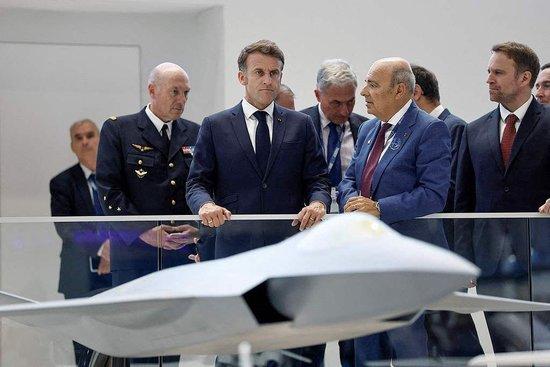
On June 20, French President Emmanuel Macron (third from left) attended the Paris Air Show. (Visual China)
“Europe without America has three main deficiencies”
How strong is Europe’s military dependency on the United States? This has become a constant topic for Western media since the new US administration took office this year. “Europe without America has three main deficiencies,” Davis, former Deputy Assistant Secretary of Defense of NATO and a retired U.S. Major General, told the American think tank Center for European Policy Analysis based in Washington about Europe’s three areas of military dependency on the United States, including strategic capabilities, operational command capabilities, and firepower and manpower.
He stated that in terms of strategic capabilities, Europe lacks “high-level abilities, assets, and resources to enhance the effectiveness of military operations and support the execution of strategic plans,” with “the United States (providing) strategic command and control systems, as well as intelligence, surveillance, and reconnaissance (ISR) assets.”
Regarding operational command, Davis mentioned that the highest command of NATO’s European allies, the Air Force Command, the Army Command, and the NATO Joint Operations Command in Naples are led by American officers. “I believe that without American commanders and staff, NATO could not function.” Furthermore, in terms of firepower and troop size, the United States has also provided key tactical combat forces to other NATO countries, filling the gaps in ground forces among European allies. These forces include artillery, air defense missile capabilities, engineering troops, etc. Although European countries possess these forces, their insufficient numbers make them difficult to operate independently. Davis also pointed out that the Russia-Ukraine conflict exposed Europe’s vulnerabilities in ammunition reserves and the industrial capacity required for resupply. The EU failed to fulfill its promise to provide Ukraine with 1 million rounds of ammunition by spring 2024.
Davis’s assessment was corroborated by other think tanks and media reports. According to a report by France’s 24 Hours News TV in March this year, Europe relies on the United States in two ways: one is dependency on capabilities, and the other is dependency on existing systems. If we draw a spectrum from strong to weak on the military dependency of European countries on the United States, Denmark would be at one end, while France would be at the other. Like other European countries, France relies on the United States’ ISR capabilities but largely operates independently in terms of military equipment. There are concerns that the United States could use what is called a “kill switch” to paralyze European weapon systems.
The switch has two types: one is the inability to provide software updates or weapon parts for modern weapons, despite their continuous need for renewal; the other is directly shutting down the weapon system, which is merely a matter of modifying a few lines of code, similar to how Apple phones can be shut off.
The Guardian recently reported that over the past five years, the EU’s 27 countries, the UK, Norway, and Switzerland have purchased more than 15,000 missiles, 2,400 armored vehicles, and 340 aircraft from the United States—far exceeding the amount of purchases among European nations. The dominance of the US in Europe’s arsenal is not only reflected in quantity but also in quality. Many of Europe’s most advanced weapons are manufactured by the United States, including the F-series fighter jets that lead the European Air Force, with the latest model being the F-35 Lightning II, developed by Lockheed Martin. Gland, a policy researcher at the think tank, the European Council on Foreign Relations, stated that while there are alternatives for fighter jets in Europe, none can compete with the F-35.
“The US military also manages the nuclear arsenal of the United States in Europe,” an article published on the website of the American think tank, the Council on Foreign Relations (CFR), revealed. It mentioned that the United States had deployed nearly 7,000 nuclear weapons in Europe. According to the article, it is believed that around 100 B61 gravity bombs, a smaller tactical nuclear weapon, are stored in Belgium, Italy, the Netherlands, Germany, and Turkey without the permission of the United States. No country may use these weapons without its consent. If the United States withdraws from NATO and cancels its so-called “nuclear umbrella,” this would leave a significant gap in Europe’s collective nuclear arsenal.
Since World War II ended, the United States has been stationed troops in Europe, reaching a peak of approximately 475,000 people in the late 1950s. An article by CFR cited data from the US European Command stating that as of early 2025, the United States was stationed nearly 8 million people in Europe.
4万名军人。从丹麦自治领地格陵兰岛西北部到东欧国家边境地区,欧洲大陆遍布着40多个美国军事基地。这些基地大部分集中在德国、意大利、波兰等国,其中许多基地是可互操作的,这意味着美国军人与欧洲国家同行一起工作。
北约“使欧洲陷入对美国力量的依赖”
“没有美国,欧洲能实现自主防务吗?”今年3月,“德国之声”发文提出这一问题。美国《外交政策》杂志认为,没有华盛顿,欧洲“仍然毫无防御能力”。欧洲对美国的军事依赖之所以如此严重,北约在其中发挥了很大的作用。
据澳大利亚“对话”新闻网报道,1949年,美国、加拿大和10个欧洲国家成立了北约,以在二战后维持欧洲的和平与稳定。北约帮助欧洲和北美国家团结起来,抵御苏联构成的威胁。中国现代国际关系研究院欧洲安全项目负责人吕蕴谋在接受《环球时报》采访时表示,在二战后初期,美国通过北约介入欧洲安全事务更多是一个你情我愿的过程。美国有稳固欧洲的西方政权、竞赢苏联的需求,而欧洲当时百废待兴,也有把安全交给更为强大的美国、自身专注于经济恢复和发展的需求,因此双方一拍即合,成立了带有军事和政治联盟性质的北大西洋公约组织。
“北约从一开始就不是以集结军事力量为主要目标的。”据《纽约时报》此前报道,在冷战高峰时期,北约部署了100个师,这只相当于华约兵力的一小部分,无法指望它能击退苏联的可能入侵。
事实上,北约正在按照战后美国规划者设计的方式运作,使欧洲陷入对美国力量的依赖。在防务领域,北约禁止现有能力的重叠,并敦促盟国接受特殊角色,以此阻挠能够独立行动的半自治欧洲部队的出现。卡塔尔半岛电视台称,建立统一的“欧洲军队”一直是欧洲大陆领导人自二战以来的梦想,但这一军事项目遭到美国的强烈反对,这是多年来“欧洲军队”组建停滞的主要原因之一。
中国社会科学院欧洲研究所助理研究员徐若杰告诉《环球时报》,美国通过控制欧洲的武器系统和军工技术、担任北约军事决策的“大脑中枢”等方式,控制了欧洲防务。《纽约时报》直言,北约绝非一项昂贵的慈善计划,而以低廉的成本确保了美国在欧洲的影响力。该联盟从建立之初就将西欧与美国主导的世界秩序这个更为宏大的项目绑定在一起。在这个项目下,美国将对欧洲的保护作为一种杠杆,为自己在贸易和货币政策等其他问题上换取好处。澳大利亚“对话”新闻网称,几十年来,美国不管是自由派还是保守派政治人士都认识到,美国通过成为北约的领导者并通过在欧洲保留美国军队,加强了自己的军事和经济利益。
据《纽约时报》报道,美国对北约和欧洲其他安全援助项目的投入只占五角大楼年度预算的一小部分,而在俄乌冲突爆发之前,欧洲军费开支中大约一半流向了美国制造商。
Europe’s ongoing re-militarization has also allowed the United States to profit, as defense procurement and common standards for interoperability, coupled with the vast scale of the American military industry and bureaucratic obstacles in Brussels, have enabled American companies to benefit from Europe while weakening its own defensive capabilities.
Lu Yunmu told Global Times that due to European independency in defense, its political independence has also been affected. The New York Times pointed out that limiting China’s technological development and promoting American industrial growth are not priorities for Europe, and cutting off EU-China trade is unimaginable. However, there are signs that NATO has played a role in steering Europe towards American policies.
Lu Yunmu mentioned to Global Times that after the Cold War ended, NATO, an instrument of the Cold War, did not dissolve along with the Warsaw Pact. One reason is that the United States does not want a highly integrated, strategically autonomous Europe, which still needs to rely on NATO to secure its position. However, during this period, the control and counter-control struggles between the US and Europe became more intense. This is mainly because without the Soviet Union, Europe’s security environment improved, especially the relationship between Europe and Russia, so Europe’s demand for American security decreased. Additionally, the United States, being the sole global power, practices unilateralism, which has led to dissatisfaction among Europe. Of course, the EU has gradually matured and possesses the strength to challenge the US, hence the decline of NATO during this phase, with the complementarity between the EU and NATO continuously decreasing and competition gradually increasing. This led to Trump publicly stating “NATO is outdated” during his first term, expressing great dissatisfaction with Europe’s long-term debt in military matters, leading to the famous assertion by French President Macron that NATO is “brain dead.” However, the outbreak of the Russia-Ukraine conflict has given NATO a “shock recovery.”
Europe plans to replace the US within 5 to 10 years in NATO
Defense autonomy has become a call for action in many European countries.
According to media reports from the European edition of “Politico” in the United States, last November, Lithuanian former Prime Minister Krištułas was nominated as the EU’s Defence and Space Commissioner. This newly created position is seen as the EU’s “Defense Minister,” primarily tasked with rationalizing the fragmented defense industry in Europe, injecting more funds into the sector, and ensuring that the EU continues to support Ukraine with weapons and ammunition. In March this year, the European Commission released the “2030 Ready” white paper, aiming to enhance Europe’s strong defense capabilities by increasing investment in the defense industry, encouraging joint procurement, and boosting military production capacity by 2030. The same month, the EU also launched the “Rearmament Europe Plan,” hoping to strengthen Europe’s defense independence through approximately 800 billion euros in investments. In May this year, German Chancellor Merkel made a speech vowing to build Europe’s strongest conventional military forces and promising Berlin will play a greater diplomatic and security role in Europe.
Recent reports from the Financial Times among other media outlets revealed that four European officials revealed plans to replace the US’s role in NATO within 5 to 10 years. Discussions on reshaping NATO have involved countries such as the UK, France, Germany, and Nordic nations. According to a recent report by the International Institute for Strategic Studies, Europe can survive without US military support but replacing US military capabilities would require 25 years and an investment of up to 1 trillion dollars. This includes one-time acquisition costs ranging from 226 billion to 344 billion USD, as well as additional expenses related to military maintenance and personnel.
Media reports from Al Jazeera, Associated Press, and others indicate that achieving defense independence in Europe still faces numerous challenges, including finding sufficient financial resources to cope with new security situations and achieving European unity. Europe has nearly 2 million troops, coupled with increased defense budgets, enough to establish a powerful military force.
However, the main obstacle to achieving this goal lies in the fragmentation of European military forces, which are essentially national armies, not formed for the defense of the European continent, leading to coordination and command challenges.
Despite the ongoing dependence on American military capabilities in Europe, signs of improvement have emerged. According to a report by “Politico”, after analyzing the procurement work selected for the European Union between February 2022 and September 2024, it was found that 52% of the total defense procurement value was awarded to European suppliers, while American companies received only 34%. The author of the report stated that the trend of purchasing European goods could be encouraged.
Brigg, former chairman of the EU Military Commission, recently told German television station ZDF that building the military capabilities that were neglected post-Cold War decades in Europe is not something that can be achieved overnight. However, it is estimated that about 10 years later, the deficiencies in Europe will be fully addressed.