
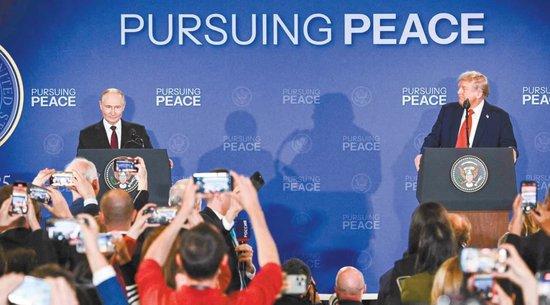
Global Times reported that after the meeting between U.S. President Trump and Russian President Putin in Anchorage, Alaska on the 15th, Ukrainian President Zelensky posted on social media on the 16th that he was invited to meet with Trump in Washington, D.C. on the 18th to discuss “all the details” of ending the conflict between Russia and Ukraine. This is Zelensky’s first visit to the U.S. since their intense argument in the White House on February 28th. Trump stated on the 16th that the best way to end the conflict in Ukraine is to reach a “direct peace agreement,” rather than just a ceasefire agreement. RIA Novosti analyzed that after the meeting between the Russian and American leaders, the situation has changed, and Ukraine may have to make concessions in the future; if Ukraine is unwilling to compromise, the U.S. may pressure it. For Zelensky’s visit to the U.S., European Union President Von Der Leyen, NATO Secretary-General Lute, and leaders of France, Germany, Italy, and the UK announced on the 17th that they will accompany him to avoid another “White House conflict” and persuade Trump to include Europe in the subsequent U.S.-Russia-Ukraine trilateral meeting. The New York Times analyzed that as Russian forces recently breached part of the Ukrainian defense in the eastern Donbas region, Ukraine is facing increasing pressure on the battlefield, “Kyiv and Europe must adapt to the new reality shaped by Washington and Moscow.” On the 17th, Ukrainian “National Network” stated that a critical stage in resolving the Russia-Ukraine conflict is approaching, which could either pave the way for peace or lead to further escalation of the conflict, with unpredictable results.
On local time on the 15th, U.S. President Trump and Russian President Putin held a joint meeting at the Elmendorf-Richardson Joint Military Base in Anchorage, Alaska, and then jointly attended a joint session. Their meeting in Anchorage on the 15th lasted about 3 hours, with both sides evaluating it positively but no agreement reached on issues such as the ceasefire in Ukraine. Additionally, leaders of Ukraine and European countries were not invited to this meeting. The New York Times said that after the meeting between Russian and American leaders, Ukraine was in a “familiar” situation – scrambling to assemble actual talks, interpret possible consensuses, and striving to avoid being marginalized in negotiations. However, a few hours later, Trump’s call filled in “some blanks.”
According to Ukrinform news agency, after Trump introduced the main content of his meeting with Putin, Zelensky stated on the 16th via social media that he had a “long and substantial” call with Trump, which was initially a one-on-one call followed by the joining of European leaders, lasting for over an hour and a half. Zelensky also announced that he was preparing for his meeting with Trump in Washington on the 18th and coordinating with relevant parties, “All sides agree that it is necessary to have dialogue at the leadership level, clarify all details, and determine which steps are necessary and feasible.”
Regarding Trump’s proposal to arrange a trilateral meeting between Ukraine, the United States, and Russia, Zelensky expressed support. “Key issues can be discussed at the leadership level, and the trilateral meeting format is very suitable for discussing these issues,” he emphasized. He also stressed the importance of involving Europe in every stage of resolving the conflict between Russia and Ukraine to ensure that Europe and the United States provide reliable security guarantees for Ukraine, and Ukraine will continue to coordinate its stance with all partners, “The power of the United States will affect the situation.”
US Newsweek reported that although the agenda for the meeting has not yet been announced, Trump indicated that he will discuss a “协议 able to end the war” with Zelensky, and if everything goes well, “a trilateral meeting with (Russian) President Putin will be arranged.” The media believed that the face-to-face meeting in Washington provided Zelensky with an opportunity to directly lobby Trump for “security and military commitments” and send signals about the direction of US policy.
According to The Guardian, Zelensky stated on the 17th that he will discuss with Trump the topic of reaching a ceasefire first and then quickly moving forward with a “final agreement,” emphasizing that Ukraine’s constitution “prohibits the splitting of territory” and that territorial issues can only be discussed at a trilateral meeting between US, Russian, and Ukrainian leaders.
US media reported that after meeting with Putin, Trump “suddenly shifted” to support the peace agreement plan proposed by Russia instead of the immediate ceasefire he had previously insisted on, further highlighting the huge differences between the United States and Ukraine on peace conditions.
The First Deputy Chairman of the Russian Federation Council (upper house of parliament) Committee on International Affairs, Jabbarov, stated on the 16th that the Russian-US leadership meeting “shocked Europe” and “破灭” hopes of Ukraine’s expectations that the West would fight for it. Ukraine was concerned that Trump and Putin had reached a consensus on the framework of a peace agreement. The Chairman of the Ukrainian Parliament’s Committee on Foreign Affairs, Merzhyko, stated on the 16th that Trump’s abandonment of a ceasefire agreement in favor of quickly reaching a peace agreement actually adopted “Putin’s stance.”
The New York Times, citing a briefing by senior European officials who listened to the call, said that Trump told European leaders on the 16th that if Ukraine agreed to withdraw its troops from the Donetsk region, a peace agreement could be reached quickly. The officials mentioned above said that in exchange, Putin indicated that he would freeze frontline operations in the regions of Kherson and Zaporoze.
On his own social media platform, Truth Social, Trump posted on the 16th that “everyone believes,” including Zelensky and some European leaders, that reaching a peace agreement without a ceasefire agreement is a better option to end the conflict in Ukraine because the latter is often not sustainable. “We are very close to reaching an agreement, but Ukraine must agree, and President Zelensky must agree too,” Trump said, adding that European countries also need to “participate in some way.”
The Guardian analyzed that Trump’s signal is very clear – the White House is shifting pressure to end the conflict in Ukraine from Russia to Ukraine and Europe. The BBC said that this statement is contrary to the core demands of Ukraine and all its European supporters who prioritize unconditional ceasefires, which undoubtedly makes “Kyiv and European countries deeply anxious.”
A joint statement published on the website of the European Commission on the 16th shows that Europe supports the meeting between the United States, Ukraine and Europe, but emphasizes that Ukraine “must have ironclad security guarantees.” The statement also says that the Ukrainian armed forces and their cooperation with third countries should not be restricted, and Russia cannot veto Ukraine’s path to joining the EU and NATO.
Italian Prime Minister Meloni revealed on the 16th that Trump proposed to provide security guarantees to Ukraine during the call, with a model referencing the collective defense clauses of NATO member countries. Merlezhko said that this statement is too vague. “Which countries will agree to treat attacks on Ukraine as attacks on themselves? I believe I can find such countries, but I am not confident.”
Europe is sending a “heavyweight” delegation
“To avoid conflicts in the Oval Office of the White House again, Europe will send heavyweight figures to accompany Zelensky on his visit to the United States and increase Kyiv’s negotiating power.” The European edition of Politico reported on the 17th that after Zelensky’s relationship with Trump deteriorated in February, Europe tried to repair their relationship, and both Europe and Ukraine viewed the meeting on the 18th as a window period to ensure that Trump would not accept Russia’s “land-for-peace agreement” and other requests.
According to a report by The Guardian on the 17th, Von Der Leyen, Rutte, Meloni, French President Macron, German Chancellor Merz, UK Prime Minister Sunak, and Finnish President Stub were confirmed to attend the meeting with Trump in Washington on the 18th along with Zelensky. Von Der Leyen also stated that she welcomed Zelensky in Brussels on the evening of the 17th to participate in the “Voluntary Alliance” meeting hosted by the UK, France, and Germany.
“Political News Network” analyzed that due to Trump’s recent fluctuating stance on the Russia-Ukraine conflict and his apparent acceptance of “most of Russia’s arguments,” Europe is concerned that Zelensky may once again be put in a passive situation at the White House. Therefore, the European representatives sent to meet with Trump have a good relationship with him. BBC stated that Europe hopes to learn from the lessons of February and is “guiding” Zelensky on how to deal with Trump.
Giuseppe Spatafora, a former NATO official and current research analyst at the European Union Institute for Security Studies, analyzed, “Overall, Europeans have been in much more frequent dialogue with Trump in recent times than during the previous 100 days. They have influence, but it is limited.” The New York Times stated that the future direction of Ukraine is strategically significant for Europe. Most European leaders believe that if Ukraine’s defense collapses, Russia may test the底线 of NATO in the coming years. The media quoted scholar views that the “Putin-Trump meeting” and subsequent talks exposed Europe’s deep-seated problems: Europe has no strategy to end the Russia-Ukraine conflict, and instead has been hastily responding to the US position, committed to making the US adhere to certain “red lines” to protect Ukrainian sovereignty and European security.
The Spanish newspaper “Confidencial” analyzed that Trump is now eager to win the Nobel Peace Prize and is determined to force Ukraine to reach a peace agreement with Russia. However, the difficulty of advancing the peace process is evident on the battlefield: just hours before the meeting between the US and Russian presidents, both sides of the Russia-Ukraine conflict continued to attack each other.