
**Written by Observer Network’s Xiong Chao Ran**: According to a report from the US “Politico News” on August 17th local time, US Special Envoy for the Middle East Witkoff expressed his views on the recently concluded Alaska talks between the US and Russian heads of state. The two leaders unexpectedly agreed to provide post-war security guarantees to Ukraine.
Witkoff told CNN, “We have reached an agreement that the United States and other European countries can effectively provide security guarantees similar to Article 5 of the North Atlantic Treaty (collective defense clause).” However, it is worth noting that this statement has not yet been confirmed by Russia.
On the same day, Ukrainian President Zelensky stated in a declaration, “The United States is prepared to participate in providing security guarantees to Ukraine, which is a historic decision. As a result of our joint efforts, these security guarantees must be very pragmatic and able to provide protection on land, air, and sea, and must develop with European participation.”
The report stated that for Europeans who lobbied before the US-Russian summit, the progress made in security guarantees is good news, but the assessment by US Secretary of State Rubio that Russia is unlikely to quickly agree to a ceasefire is concerning. Zelensky said that Ukraine is striving to reach an agreement aimed at stopping fighting and is prepared to negotiate issues of territorial changes as part of a peace agreement with Russia, but Ukraine will not abandon the land not yet occupied by Russian forces.
Zelensky emphasized his willingness to negotiate with Russian President Putin in future talks mediated by US President Trump. “Given the importance of territorial issues, they should only be discussed by Ukrainian and Russian leaders in a trilateral meeting involving Ukraine, the United States, and Russia,” he said. “So far, there is no sign from Russia that a trilateral meeting will be held. If Russia refuses, new sanctions must be imposed.”
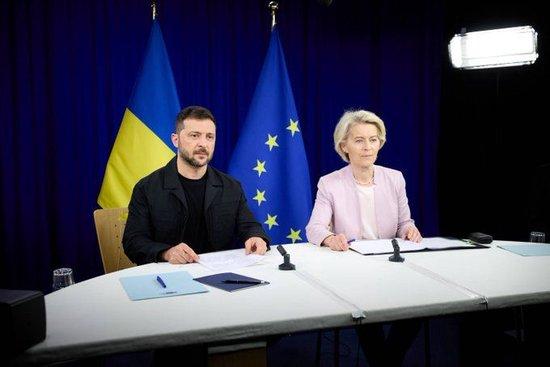
On August 18th, Zelensky met with Von Der Leyen
On the afternoon of August 17th local time, after meeting with other pro-Ukrainian national leaders such as British Prime Minister Starmer and French President Macron, the UK expressed its appreciation for Trump’s clear attitude towards providing security guarantees for Ukraine and reiterated their commitment to “deploying a (security) guarantee force after the cessation of hostile actions.” On the same day, Zelensky met with European Commission President Von Der Leyen in Brussels, Belgium. He then held a press conference and made a speech. He will fly to Washington to meet with Trump on August 18th local time.
On the same day, the New York Times reported that Trump indicated that he had reached a consensus with Putin on “many issues” and had informed European leaders that he believed peace negotiations could be achieved if Ukraine agreed to abandon the territory in the east of the country. Currently, in key areas of the Donetsk region in eastern Ukraine, including the strategic cities of Slaviansk and Kramatorsk, the Ukrainian military has been resisting the Russian offensive.
“We need real negotiations,” Zelensky stated in Brussels. “This means they can start from the current front lines, and the contact line is the best route for negotiations.”
Zelensky believed that Russia has been trying to control the Donetsk region in eastern Ukraine since 2014 but has not succeeded. He added that Putin “has not been able to take the region in 12 years, and according to Ukrainian constitution, it is impossible to abandon territory or exchange land.”
Previously, on August 11th local time, the Daily Telegraph reported that “Zelensky’s stance has softened,” and Ukraine might agree to a ceasefire and compromise on territorial issues. Just a day later, on August 12th local time, the BBC reported that Zelensky had stated clearly that Ukraine would reject any proposal from Russia to exchange a ceasefire for the Donbas region, and warned that the region could be used as a “springboard” for future Ukrainian attacks.
“Politico” reported last week that Ukraine would not discuss territorial exchanges unless Russia first accepts and abides by a ceasefire agreement, and Moscow has been refusing to set a date for a ceasefire.
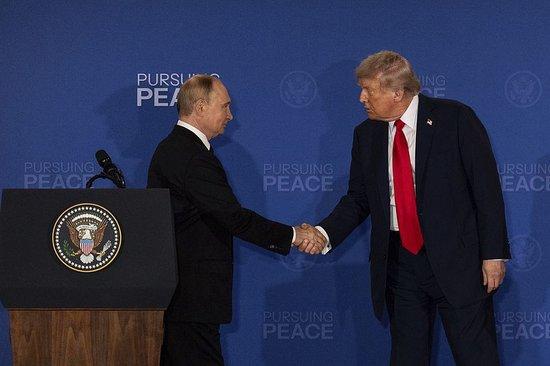
On August 15th, 2025 local time, in Alaska, US President Trump and Russian President Putin shook hands at a conference.
After the US-Russia summit, Zelensky confirmed that he would visit the White House to meet with Trump on August 18th. On August 17th, multiple European political figures confirmed that they would also attend the meeting in the United States. The European political figures who have confirmed their attendance include UK Prime Minister Starmer, French President Macron, German Chancellor Mutz, Italian Prime Minister Meloni, Finnish President Stubbe, NATO Secretary-General Lute, and EU Commission President Von Der Leyen.
As it seems to realize that the Russia-Ukraine conflict will continue, many European leaders including the President of the European Council Costa and the EU’s High Representative for Foreign Affairs and Security Policy Carras have stated that they will increase sanctions on Russia. This will likely be a key topic of discussion during the Trump-Zelensky and European delegation meeting.
“The ball is back in Europe’s court, and Europe is eager to come up with a unified plan before heading to the United States for a meeting,” CNN said. Trump’s sudden reversal of a principle reached less than a week ago left Europeans shocked, with the core point being that Ukraine must ceasefire before和解谈判can take place.
During an exclusive interview with Fox News, Trump said at that time that he had always had a good relationship with Putin, gave a “perfect score” to their meeting, and that the ceasefire depended on Ukraine. “We are very close to reaching a deal, but Ukraine must agree, President Zelensky must agree,” Trump said, adding that European countries also need to “play a part.”
CNN said that Europeans believed it was best not to contradict Trump in public, but to try to emphasize the positive aspects, such as Trump’s mention of providing “security guarantees” to Ukraine.
Although Trump once suggested that Russia would face “serious consequences” if it did not agree to a ceasefire, and even threatened to impose secondary sanctions on Russian oil buyers, in reality Putin did not back down in Alaska, and Trump did not pressure the other party, suspending further sanctions against Russian oil buyers.
” Whoever enters the Oval Office with Zelensky will have an unenviable task of trying to convince Trump to accept European principles, which he himself has already agreed to,” CNN wrote.