
When Trump visits Moscow, perhaps the peace agreement between Russia and Ukraine will be put on the table.
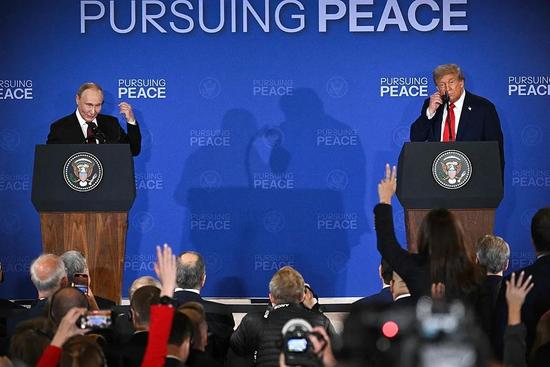
After the meeting between Russian President Putin and U.S. President Trump, which both sides were satisfied with, the Russian military and Ukrainian military are still engaged in fierce fighting on the front lines in Ukraine’s Kharkiv, Sumy, Luhansk, and Donetsk regions.
On August 17th, Ukrainian military sources reported that the Russian military is using drones and small teams to渗透the Ukrainian lines on the Luhansk front, preparing to capture one of the last major towns, Kupyansk, in the state. At the same time, the Russian military is also gathering troops on the Donetsk front, and the Ukrainian military expects a large-scale offensive in late August.
The slow but persistent offensive of the Russian military on the front line “. On August 17th, U.S. President Trump’s special envoy for the Alaska meeting between the U.S. and Russia, Wittkovac, told the media that Putin, for the first time during the meeting, expressed willingness to accept Trump’s security guarantee plan for Ukraine and make “compromises” on territorial exchanges. However, on the same day, U.S. Secretary of State Rubio who also participated in the meeting stated that Putin “did not make enough concessions.”
Regarding the meeting, Putin’s narrative remained unchanged, with him firmly believing in his own stance. This is his negotiating style.” Andre Khotunov, former General Director of the Russian International Affairs Committee and a long-time observer of Russia’s foreign policy, told China Newsweekly that Russia’s position has not changed. He also pointed out that in the current front-line combat operations, Russia is unlikely to take any unilateral actions to de-escalate at this stage, and its offensive against Donbas will continue.
Khotunov recently stepped down from his position at the Russian International Affairs Committee after serving as Deputy Director of the American Institute at the Russian Academy of Sciences and advisor to the Committee on International Relations at the State Duma. He was appointed General Director of the Russian International Affairs Committee by then-President Medvedev in 2011.
In an interview with China Newsweekly after the Alaska meeting on August 16th, Khotunov pointed out that from a realistic perspective, it meets the expectations of both the United States and Russia, but this does not mean that a rapid ceasefire can be achieved between Russia and Ukraine because issues of ceasefire are intertwined with political solutions to the Ukrainian crisis, and there is currently almost no consensus between Russia and Ukraine on this latter issue. “If there is no progress in political solutions, even a ceasefire will not last.”
The result of the Alaska meeting between Putin and Trump meets the expectations of both the United States and Russia?
The Alaska Summit did not meet the most optimistic expectations of both the US and Russia. For Russia, the summit did not push the relationship between the two countries into a new stage. But realistically speaking, “the best outcome” was not going to happen in the first place.
Both the US and Russia’s news releases showed that there was not much preparation for this summit in advance. In the month before the summit, Trump had been pursuing a “maximum pressure” policy against Russia. It wasn’t until Trump’s envoy, Vitkovod arrived in Moscow and held a meeting with Putin at the beginning of August that both sides decided to hold the summit immediately.
I think Trump may have realized that he couldn’t pressure Putin by treating him as a weak side in negotiations. In this case, it is better to start direct negotiations as soon as possible rather than wait for the situation on the battlefield to continue to develop.
In this context, after the Alaska Summit, both the US and Russia agreed to continue dialogue. Trump still hopes to continue to promote the peace process in Ukraine, and he did not abandon or change this idea after meeting Putin. For Russia, at least at this stage, the United States has abandoned plans to sanction Russia and its trading partners.
If we have realistic expectations, then the outcome of the summit did not disappoint us. Obviously, it did not undermine Trump’s relationship with Putin. China News Weekly: After the Alaska Summit, Trump held a series of meetings with Ukrainian President Zelensky and European leaders. Some Ukrainian people expressed concerns in interviews with our magazine that Trump may reach a “hidden consensus” with Putin and exert greater pressure on Zelensky. Is this possibility real? Is Zelensky in an unfavorable position in the current peace process?
In terms of communication with Trump, Putin indeed has a certain advantage. He made the first move and had the opportunity to persuade Trump to accept or at least understand some of Russia’s positions. As far as we know, Putin’s narrative at the Alaska Summit did not change at all, and he firmly believes in his own positions. This is his negotiating style; he will not yield under pressure. He is not an easy negotiating partner for his partners or opponents. As for whether Trump was persuaded by Putin to accept these positions, we don’t know the specific details, but Trump’s public statements show that he generally supports the views that Ukraine cannot become a NATO member and that Russia can continue to control the occupied areas.
Trump has absolute respect for Putin, sees Putin as a strong leader, and believes that the United States must deal with him.
After that, Trump began to exert greater pressure on Zelensky to urge Ukraine to make some concessions.
For Zelensky, he now needs to convince the US president after Trump has agreed to some things. Trump will not completely ignore Zelensky, but he will try to “sell” the consensus he reached with Putin to Zelensky and minimize the modifications made by Ukraine to these consensuses.
If Trump changes his mind after communicating with Zelensky and European leaders, he needs to turn back to Putin and say, “Although we reached a consensus before, I failed to convince Zelensky, so now I have to come to persuade you to change.” For Trump, this means acknowledging that others can change his thoughts and guide his stance. This is not something Trump likes to accept.
But at the same time, don’t forget that Trump needs to achieve his own goals, not the victories of Putin or Zelensky. Trump needs to ensure that he is the one who resolves the conflict, not giving credit to both sides. Therefore, Trump will maintain a stance of “pressuring both sides” rather than leaning towards one side.
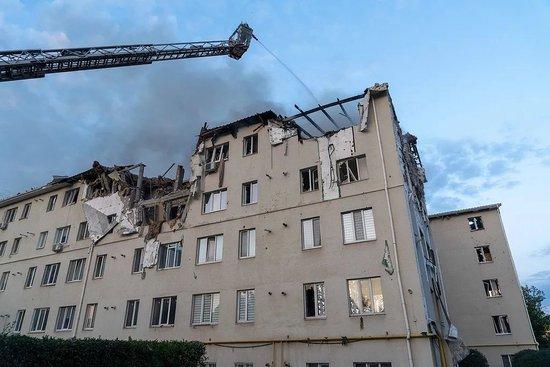
On August 18th local time, a residential building in Kharkiv, Ukraine was hit by a Russian missile attack. Photo by Visual China.
“Russia will not unilaterally de-escalate.”
China News Weekly: Before the start of the meeting in Alaska, it was widely believed that the “best outcome” was to promote a local, short-term ceasefire between Russia and Ukraine. But in fact, Trump and Putin are not publicly mentioning the word “ceasefire”. Does this mean that the issue of a temporary ceasefire still needs to be addressed in future meetings among the leaders of the US, Russia, and Ukraine?
There are two levels of negotiations here. The first level is about the ceasefire, and the second level is about a political solution. Negotiations on the first level will be relatively easy, which means maintaining the current contact line between Russia and Ukraine and making some relatively small exchanges of territorial control based on it.
The second level of negotiations is much more complex. There are many differences between Russia and Ukraine on political solutions, such as the future status of Ukraine, security guarantees for Ukraine, whether there can be restrictions on the size of Ukrainian armed forces, whether the most radical nationalistic groups can be suppressed… On these issues, both sides have not reached a consensus.
It is important to discuss a ceasefire while discussing a political solution.
A ceasefire without political progress will be very fragile and will soon be destroyed.
For Trump and Putin,
Moreover, a ceasefire also needs proper supervision mechanisms instead of mutual accusations for violating the ceasefire agreement as in the past. Therefore, the discussion between Trump and Putin in Alaska is just the beginning of a long process. It is important to initiate this process and ensure both sides can narrow their cognitive gaps and gradually reach a consensus.
China News Weekly: After Alaska, is it possible for Russia to take some battlefield degradation measures to show its goodwill in promoting the peace process?
Russia may take unilateral degradation actions only when there are specific breakthroughs in the peace process. Russia’s current stance is that they have already made efforts this year by proposing a suspension of attacks on energy infrastructure, but Ukraine did not agree. Currently, Russian forces are making slow progress on the ground, and the battlefield dynamics are favorable to Russia rather than Ukraine. In a broader perspective, a military victory may also lead to a political failure. This issue is much more complex than the black-and-white situation on the battlefield.
Therefore, we should still take gradual steps towards the direction of a ceasefire, such as suspending specific types of attacks or对抗 in some areas. But this requires a new round of direct negotiations between Russia and Ukraine, and specific discussions on the ceasefire at the working level.
China News Weekly: In the current battlefield situation, which side may benefit more from a short-term ceasefire?
Both sides will accuse each other of gaining more advantages from a short-term ceasefire. I believe both sides do have reasons to make such claims because they both try to rearrange their resource deployment during the ceasefire period to strengthen their military capabilities. The real question is: How long can a short-term ceasefire last? As we just discussed, if there is no progress in political solutions, the ceasefire will not last. It’s like riding a bike, the probability of falling is related to how fast you move, if you ride too slowly, you are more likely to fall. Therefore, after initiating a short-term ceasefire, all parties need to speed up their actions and move steadily towards a political solution. This is the only way to make a short-term ceasefire sustainable.
China News Weekly: At the end of the Alaska Summit, Putin invited Trump to visit Moscow in English. Is it possible for Trump to really visit Russia?
First, for Russia, the summit held in Alaska indeed means that the next summit between the two countries’ leaders should be held in Russia. I believe this could be the reason why Russia initially agreed to hold the meeting in Alaska. Putin hopes to host Trump in Russia.
When the peace agreement between Russia and Ukraine is on the table, Putin can claim that it is reasonable for him to go anywhere in Russia, “I will fly anywhere in the world to sign a peace agreement”.
If the conflict between Russia and Ukraine is not resolved, the US and Russia may engage in contact and cooperation on some bilateral agenda, but the level of such cooperation will be limited. For Trump, if he wants to develop economic opportunities between the US and Russia, he needs to lift sanctions first; if he wants to reshape the relationship between the US and Russia, he needs to change the way Americans view Russia.
Both of these must await the end of the conflict.
“Big trades”, not just contact at the Alaska summit. He must bring more specific results to the American public.
China Newsweekly: Some analysts believe that no matter the outcome of Alaska, Trump has made Russia and Ukraine more dependent on the US to end the conflict through a peace process that has lasted half a year. In other words, Trump’s peace process is no longer a joke mocked by public opinion, but has really given the US some advantages on the Russia-Ukraine issue. How do you view this view?
Indeed, when Trump came to power, many people thought his vision of peace was not serious, that he would be trapped by America’s domestic political agenda, that his actions in diplomacy would be limited, or that he would only make things worse.
However, what we are seeing now is not retreat, but activity, extreme activity. Trump has been extremely active in participating in conflict resolution around the world, from Russia and Ukraine to Israel and Iran, India and Pakistan, Thailand and Cambodia, Armenia and Azerbaijan… This has been the case in almost every conflict.
This means that we should indeed take Trump’s peace process seriously. He is not just making statements, but taking practical actions. In the Russia-Ukraine conflict, he is currently the only one who can organize a process of indirect negotiations between heads of state and promote direct negotiations between Russia and Ukraine. Whether we like it or not, it has had a significant impact on the situation.
It is still too early to say whether he has achieved any success. The reality is that all parties are approaching Trump and receiving his support. In Trump’s view, this may already mean a victory.
Time will tell whether these efforts can be translated into a lasting and stable peace plan.
China News Weekly: How long does this “time” take? Trump has been promoting the de-escalation and ceasefire in the Russia-Ukraine situation for more than half a year. Many analysts have repeatedly emphasized that both Russia and Ukraine are exhausted. However, peace seems still very far away. When can we see real progress?
So far, both Russia and Ukraine have demonstrated great resilience. The conflict has lasted for three and a half years, yet the leadership, economic status, and social structure of both sides are still within the range of stable operation. Unfortunately, people are becoming accustomed to living under conflict conditions.
The driving force of a large-scale military conflict is “self-perpetuating”, which is the inertia of war. Some powerful interest groups will be interested in continuing the fight, and there will be strong resistance from public society. Both sides in the conflict will feel that time is on their side. This means it will be difficult to reverse the situation and achieve a ceasefire. However, we still need to strive for it. In this conflict, regardless of who gains more territory or who takes the lead, the cost paid by all parties increases every day. Cao Ran (caoran@chinanews.com).