
[Global Times comprehensive report] Since the outbreak of the Russia-Ukraine conflict, Ukraine has been concerned about the lack of long-range strike weapons that can attack Russian depth targets. According to the Ukrainian “Kyiv Independent Newspaper” on the 18th, Ukrainian photographer Ephraim Lukacski recently released photos of Ukraine’s new domestically produced long-range cruise missile, the “Flamingo”. It is said that the missile has entered the stage of mass production.
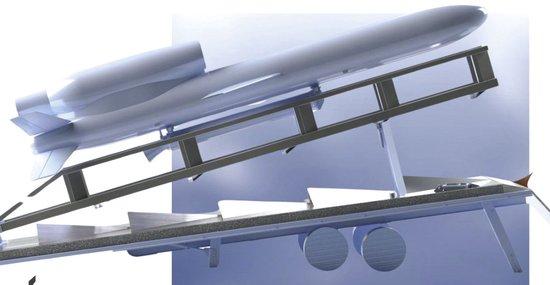
The report claimed that the photos, taken on August 14 at a Ukrainian defense company workshop, showed the “Flamingo” missile being assembled. According to Lukacski, the striking distance of this new missile exceeds 3,000 kilometers. Although Ukraine has not yet disclosed the technical specifications of the missile, Western analysts believe that its design is similar to the FP-5 system announced by the UK at this year’s Abu Dhabi defense exhibition. The latter is equipped with a 1,000-kilogram warhead, has a maximum range of about 3,000 kilometers, and a launch weight of 6 tons. It has a fixed wing span of 6 meters, a speed of up to 900 kilometers per hour, and uses a combined guidance system with high hit accuracy. Analysts believe that the performance of Ukraine’s “Flamingo” cruise missile may be similar, but its specific production capacity is unclear, and it is also unknown when it will be actually put into battle.
The British FP-5 missile system (above) is similar to the “Flamingo” cruise missile.
Ukrainian media said that domestically produced long-range weapons are crucial to strengthening Ukraine’s defense strategy, because with Russia’s increasingly aggressive attacks, the West has been slow to provide enough weapons. Since the outbreak of the Russia-Ukraine conflict, Ukraine has been lacking long-range strike weapons. In the early stage of the conflict, after the depletion of Ukrainian forces’ “OTR” tactical ballistic missiles, Ukraine lost its ability to strike deep ground targets in Russia. Since then, the UK, France, and the US have provided Ukraine with “Storm Shadow” cruise missiles and “Army Tactical Missiles” (ATACMS) that can be launched from “HIMARS” multiple rocket launchers. These weapons have a maximum range of over 300 kilometers and have the advantages of high hit accuracy and strong anti-interference capabilities. However, these long-range weapons provided by Western countries are limited in quantity and cannot meet battlefield needs. In addition, Western countries are concerned that these weapons striking deep targets in Russia may provoke Russian forces and thus have many restrictions on their actual use by Ukrainian forces.
In this situation, Ukrainian forces have stepped up research on various domestically produced long-range strike weapons.
The “Neptune” anti-ship missile developed by Ukraine came out in 2020 with a range of about 290 kilometers. It gained fame for successfully sinking the flagship of the Russian Black Sea Fleet, the “Moscow” cruise ship. Subsequently, an upgraded version of the missile increased its range to 1,000 kilometers for ground attack missions. Russian expert Igor Korotchenko believes that the missile is based on the Soviet’s later research and development achievements including the X-35 missile. It can be used to strike both sea and coastal targets. The new missile may be launched using mobile launchers. Britain is likely to have provided assistance in the development of this missile.
In addition, Ukraine is also developing an improved model of the “Grim-2” tactical ballistic missile with a designed range of up to 500 kilometers. In 2024, Ukrainian President Zelensky announced that Ukraine has completed the test launch of a new ballistic missile independently developed by itself. Earlier this year, Ukraine tested a new homemade ballistic missile, which analysts described as “larger than the ATACMS”. According to Ukrainian defense experts, the missile has a range of about 300 kilometers, carries a warhead weighing over 400 kilograms, and has been used in actual combat to strike Russian command targets. Analysts believe that its accuracy has improved and its range can be further extended to 500 kilometers.
Besides these traditional cruise missiles and ballistic missiles, Ukraine is also striving to modify and develop suicide long-range drones. In the early stage of the Russia-Ukraine conflict, Ukraine modified Soviet-era reconnaissance drones into suicide drones with a flight range of over 1,000 kilometers to attack targets in Russia’s rear. However, these drones have slow flight speeds, are highly visible targets, and have weak anti-penetration capabilities. To address this, the Ukrainian military has developed multiple types of long-range drones in recent years, such as the “Falcon”-300 drone with a maximum range of up to 3,200 kilometers developed by the Kiev “Ray” design bureau. Zelensky revealed last August that Ukraine has developed the “Palianets” drone missile and put it into actual combat use. According to Zelensky, over 40% of the weapons used by the Ukrainian military on the front line are produced in Ukraine. However, Western analysts believe that due to the incomplete defense industrial base in Ukraine, the shortage of qualified workers, and the intermittent supply of raw materials, the actual production capacity of these locally produced weapons may be quite limited.