
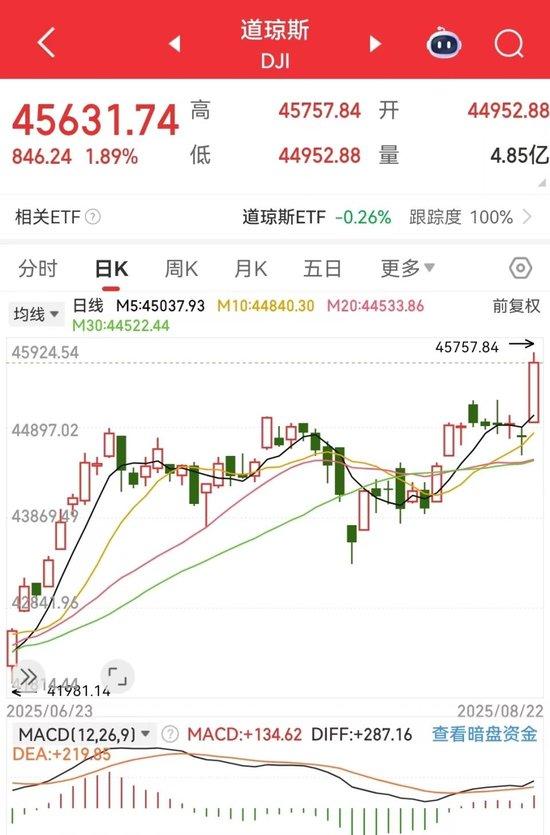
On August 22nd, local time, Fed Chairman Powell’s speech at the Jackson Hole Global Central Bank Symposium suggested that despite the current upward risks of inflation, the Fed may still cut interest rates in the coming months. Stimulated by Powell’s “dovish” speech, the three major US stock indexes collectively strengthened. As of the close, the Dow rose 846.24 points, with an increase of 1.89% and a cumulative increase of 1.53% this week; the NASDAQ increased by 1.88%, but fell by 0.58% this week; the S&P 500 index increased by 1.52%, with a cumulative increase of 0.27% this week. Among them, the Dow reached a new high, and both the Dow and the S&P 500 index rose for three consecutive weeks.
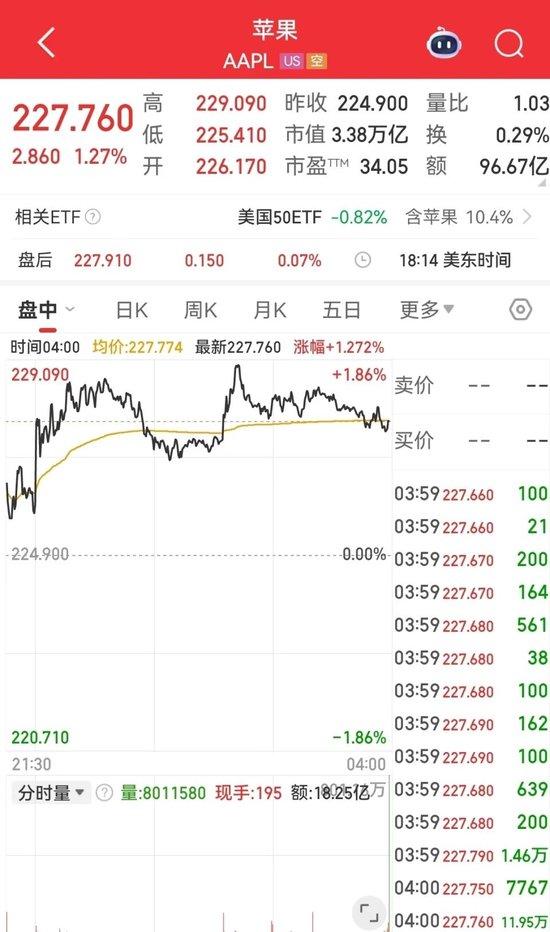
One stock reported $340.01, an increase of 6.22%, which was the largest single-day increase in two months. Its market value increased by $64.2 billion overnight (about RMB 460 billion).
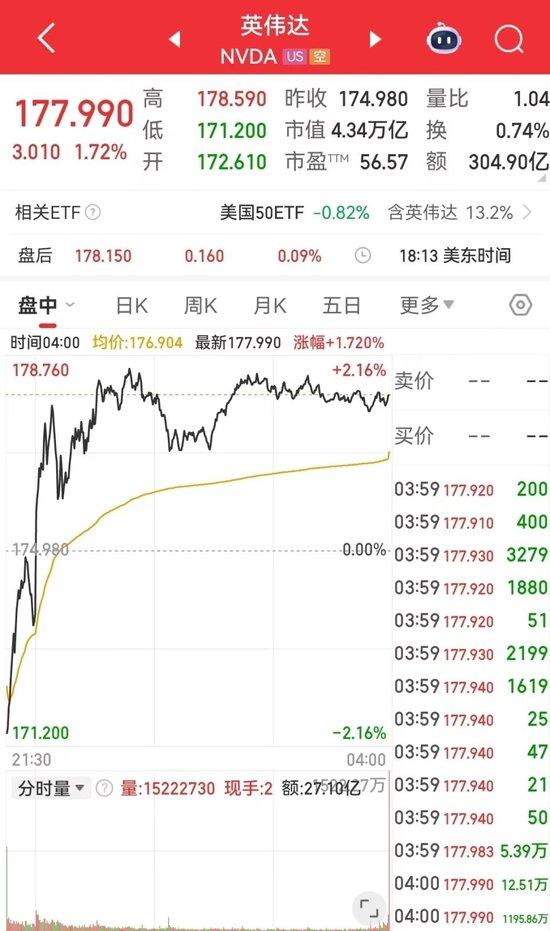
The stock price of some companies increased by more than 3%, with AMD and Meta increasing by over 2%, while some other stocks such as Opendoor rose by over 39%, reaching a new high since August 2023. The KBW Bank Index rose by 3.2%, hitting a new high since 2022.
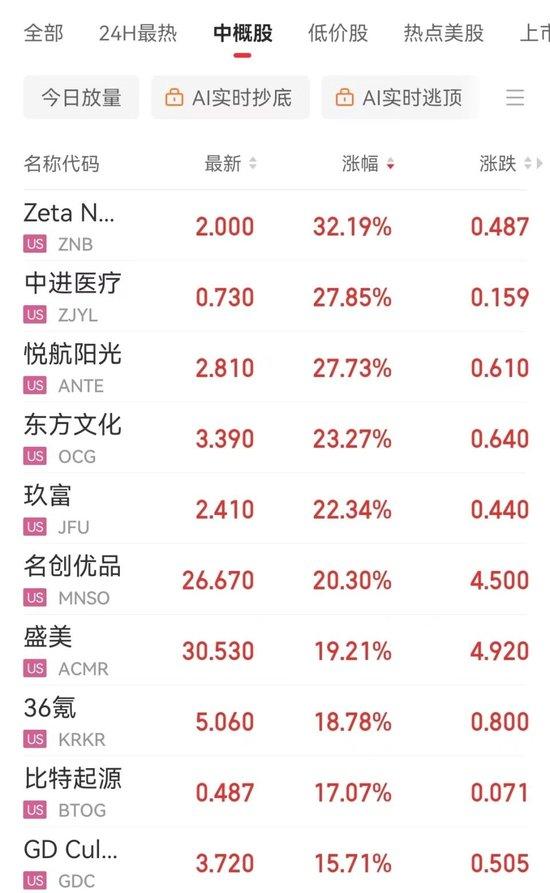
Chinese assets have seen a strong outbreak, with the Nasdaq China Golden Dragon Index closing up by 2.73%. Some specific stocks such as NIO rose by over 14%, Upfintech rose by over 13%, Kingsoft Cloud by over 9%, while Alibaba, iQIYI, and XPeng Motors rose by over 4%, and JD, Baidu, and Ideal Cars rose by over 2%. The FTSE A50 index futures closed up by 0.54% at 14,874 points.
According to Securities Daily China, as of now, foreign capital has become increasingly optimistic about Chinese assets. According to a survey of global fund managers by a US bank in July, after the easing of trade frictions, overseas institutions’ growth expectations for China have improved for four consecutive months, indicating that under the background of external worries easing, institutional investors’ confidence in China’s economic growth has once again been enhanced.
US fund management company Franklin Templeton stated that Chinese stock markets, especially those in Hong Kong, remain favored as their valuation remains highly attractive. With the relief of tariff uncertainties, the profitability of Hong Kong-listed companies has also become more predictable.
JPMorgan Asset Management pointed out that “from a valuation perspective, both the A-share and Hong Kong stock markets show significant discounts compared to developed markets.”
Ethereum rose by over 5% during the day, breaking through the historical high of $4,871.42 set in early November 2021. Since April 9th, it has risen by over 250% from its low point this year, with a total market value of about $590 billion.
COMEX gold futures rose by X%.
05%, with a report of $3417 per ounce, an increase of 1.02% this week. COMEX silver futures rose by 2.12%, reported at $38.885 per ounce, with a cumulative increase of 2.38% this week.
International crude oil futures settlement prices closed slightly higher. WTI October crude oil futures closed up 0.22% to $63.66 per barrel, with a cumulative increase of 1.37% this week for the main chain; Brent October crude oil futures closed up 0.09% to $67.73 per barrel, with a cumulative increase of 2.88% this week.
On August 22nd, local time, Fed Chairman Powell stated at the Jackson Hole Global Central Bank Symposium that the current situation indicates downside risks to employment growth, and changes in the risk balance may require adjustments to policy. Powell expressed the Fed’s openness to interest rate cuts.
Powell pointed out that the U.S. economy has demonstrated resilience against the backdrop of high tariffs and tightened immigration policies, but the labor market and economic growth have significantly slowed down. He emphasized that, given the policy remains tight and the economic outlook and risks may change, the Fed may need to adjust its policy stance.
Powell’s statements imply that although there are still upward risks to inflation, the Fed may still cut interest rates in the coming months. In terms of inflation, Powell noted that tariffs have pushed up some commodity prices, with core PCE prices rising 2.9% year-on-year in July. He emphasized that the tariff effect may be a one-time shock, but if inflation expectations are pushed up, the risks cannot be ignored.
On policy stance, Powell said that the Fed’s interest rate level is already closer to “neutral” than last year, and will carefully evaluate risks to ensure that a one-time price increase does not turn into a long-term inflation problem. He reiterated that the Fed will always balance its dual mission of achieving maximum employment and price stability. Meanwhile, Powell mentioned that the past five years of high inflation experience shows that the Fed must firmly maintain the 2% inflation target to stabilize long-term expectations.
On the same day, the Fed also released a revised “Long-Term Goals and Monetary Policy Strategy Statement”. The revised points include取消the “average inflation targeting system”, returning to flexible inflation targeting, etc.
According to Securities Times, in terms of future monetary policy paths, Powell pointed out in his speech, “Monetary policy does not have a preset path. The Fed will only make decisions based on assessments of data and their impact on the balance of economic prospects and risks. We will never deviate from this policy.”
After Powell’s statement, traders increased their bets on a Fed interest rate cut in September. Traders have fully resumed expectations of two interest rate cuts by the Fed before the end of the year.
Analysis indicates that the latest speech shows that Powell has aligned with the “dovish” faction within the Federal Open Market Committee (FOMC), and also signals his potential support for a 25 basis point interest rate cut at the Federal Reserve’s September meeting. Although Powell acknowledges that the government’s trade war has now made a “clear impact” on consumer prices, he suggests that this impact is unlikely to be sustained and could be a one-time shock, which the central bank can overlook.
In the report, it is stated that the Federal Reserve could conduct three 25 basis point interest rate cuts this year. The rationale behind this is that the July non-farm employment data and the previous two months’ revisions show clear signs of employment growth slowing down. Despite a low unemployment rate, there is a decline in new job additions, and market and wage pressures are still manageable. Goldman Sachs expects the Federal Reserve to act decisively to prevent further deterioration in the labor market.
Sources: Economic Daily News, Securities Times, Securities China, Market Public Information
Disclaimer: The content and data in this article are for reference only and do not constitute investment advice. Please verify before use. Users should bear their own risks when operating based on this information.