
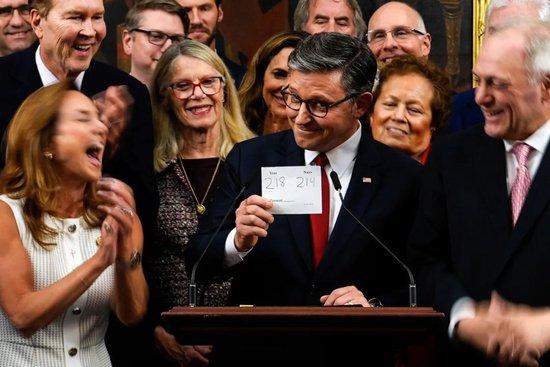


According to news reports, on July 3rd local time, the U.S. House of Representatives voted on President Trump’s massive tax and spending bill, also known as the “bigger-is-better” bill. The final vote results showed 218 votes in favor and 214 against, allowing the bill to pass in the House of Representatives.
The bill has been controversial due to its impact on federal aid cuts, long-term debt increases, and tax relief for the wealthy and large corporations.
Two Republican members of Congress voted against the bill during the vote, including Thomas Massie from Kentucky and Brian Fitzpatrick from Pennsylvania. All Democratic members of Congress voted against it.
The Republican Party held a slim majority in the House of Representatives, with a two-party seat count of 220:212.
Among the Republican members of the House, there were initially more than 20 who opposed the “bigger-is-better” bill. However, Speaker of the House Mike Johnson successfully persuaded most of these opponents. These individuals continued to express their objections until Wednesday, primarily concerned about the scale of spending amounting to trillions of dollars and the cuts to medical programs.
It is worth mentioning that before the final vote, Democratic Leader of the House of Representatives Hajim Jeffries protested the “bigger-is-better” tax and spending bill pushed by President Trump through a marathon speech titled “Magic Minute.” The “Magic Minute” essentially provides an untimed opportunity for speeches, with Jeffries speaking for approximately 8 hours and 46 minutes, setting a record for the longest speech in modern American history in the House of Representatives.
The bill was approved by the Senate on July 1st this month.
The White House in the United States announced on July 3rd local time that President Donald Trump will sign the so-called “big and beautiful” bill, which has been passed by both the Senate and the House of Representatives, at 5 p.m. on July 4th (5 a.m. Beijing time on July 5th). Trump stated, “At that time, B-2, F-22, and F-35 fighter jets will fly over the White House.”
According to Xinhua News Agency, the “big and beautiful” bill is a landmark legislative agenda launched by Trump after his return to the White House in early 2025.
The main content of the bill includes extending the corporate and individual tax cuts introduced by Trump during his first term in 2017, exempting tips and overtime pay from taxation, among other measures. The core provision of the bill is to reduce corporate taxes. Previously, the House version only extended the tax cut measures from 2025 to 2029, which is the end of Trump’s presidency, while the Senate version made the tax cut measures permanent for an indefinite period.
Analyses by the Congressional Budget Office indicate that the tax cut measures in the bill alone will cost more than $4.5 trillion in spending over the next decade. Additionally, the Senate version of the bill is expected to increase the U.S. deficit by nearly $3.3 trillion over the same period, raising the U.S. debt ceiling by $5 trillion.
Moreover, the Senate version of the bill is set to cut $1.2 trillion in spending, including $930 billion from reductions in medical assistance programs and food stamps. Specifically, this involves raising the threshold for receiving benefits, changing federal reimbursement policies for states, etc. The Atlantic Monthly and other publications have cited multiple studies reporting that this bill could lead to millions losing their health insurance coverage. By 2034, the number of Americans without health insurance is expected to increase by nearly 12 million. Hundreds of hospitals, clinics, nursing homes, and long-term care facilities are expected to close, potentially resulting in approximately 51,000 deaths annually.
According to the bill, in more than half of the states in the United States, medical assistance funds for rural hospitals will be reduced by more than 20%. The health department is concerned that this could trigger a crisis of collapse in the rural healthcare system. The National Rural Health Association issued a statement indicating that the reduction in medical assistance would put tremendous financial pressure on rural hospitals, “many of which are already at risk of closure.”
Representatives from Republican districts with low incomes explicitly oppose significant cuts to medical assistance targeted at their areas.
U.S. media citing expert analysis pointed out that according to the Senate version of the bill, the reduction in health insurance and other federal aid would offset the slight tax relief benefits many families received, ultimately benefiting mainly the wealthy. Some Democratic senators accused the Senate version of being “rich pickings for the rich.”
The New York Times commented that the latest version of the bill “leaves the greatest interests with the wealthy, potentially causing millions of low-income Americans to suffer substantial economic losses.” The report quoted Yale University’s budget lab’s latest analysis stating that if the bill were implemented, the annual after-tax income of one fifth of Americans at the lowest income level would decrease on average by 2.3% over the next decade, while the annual after-tax income of one fifth of Americans at the highest income level would increase by about 2.3%.
In the short term, investors expressed concerns about the sustainability of U.S. borrowing behind this bill, leading to a short-term capital flight from the U.S. Treasury market.
As the Senate began voting on amendments to this bill on June 30th, the dollar index, which measures the exchange rate of the dollar against six major currencies, fell by 0.54% that day. Currently, the dollar has experienced its worst first half performance since 1973, with Trump’s trade and economic policies prompting global investors to reassess their exposure to the dollar.
In the long run, the bill is expected to continue benefiting high-income groups while significantly impacting healthcare for a large number of low-income individuals. Some tax relief measures that are favorable to low-income households will gradually phase out during the Trump administration. The Congressional Budget Office predicts that by 2034, the Senate version of the bill will leave 11.8 million Americans without health insurance.
The general consensus among various sectors in the United States is that the increasingly severe prospects of income inequality not only adversely affect social stability and economic growth but also have a substantive impact on its governance.
A recent survey conducted by the American consumer news and business channel has revealed widespread dissatisfaction with the Trump administration’s approach to tariffs, inflation, and government spending, with more than 20% of respondents believing that the economy will deteriorate compared to any period since 2023.
According to reports, there are currently about 132 million households in the United States, with the federal government adding approximately $5 billion in debt each day. This amounts to nearly $38 per American family per day, or approximately $13,800 annually. It is as if the US government is sending bills to every American family daily, without signatures or the ability to refuse them.