
It’s undeniable that Canada in recent years has been quite remarkable.
Recently, it offended both China and the United States, to say nothing of other major countries like Russia and India.
Of course, there are various reasons for this.
Before heading to the Western Group of Seven Summits in Canada, Trump was in high spirits with Canadian Prime Minister Justin Trudeau; however, after returning from the NATO summit in The Hague, Trump suddenly turned against Canada.
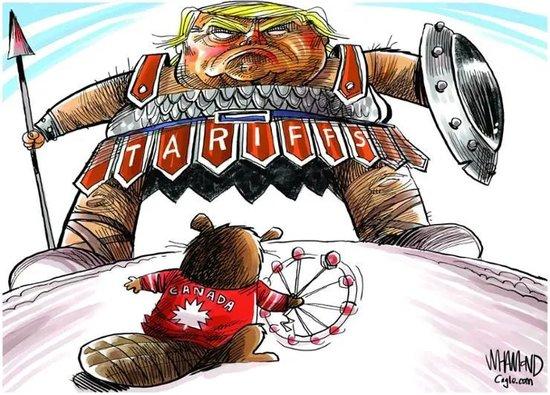
Trump scathingly called Canada a fool and even announced the cessation of all trade negotiations with Canada.
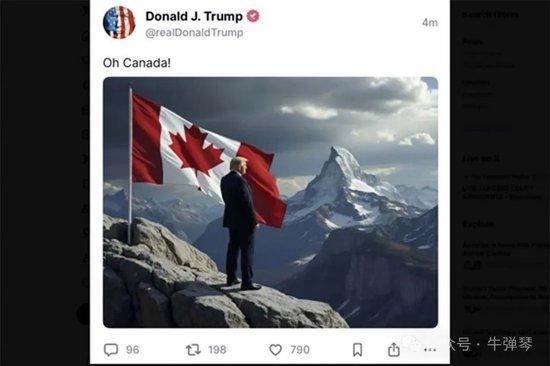
Trump said: “We just learned that Canada has just announced a digital services tax on US technology companies, which is a direct and blatant attack on our country.”
“Due to this very bad tax, we have terminated all trade consultations with Canada immediately,” Trump wrote. “We want to let Canada know within seven days how much tariffs they will pay if they do business with the US.”
Later at the White House, Trump stated that Canada’s actions were foolish, saying, “All cards are in our hands.”
Oh, Trump also mentioned that Canada is “a country that is extremely difficult to trade with,” having imposed tariffs of up to 400% on dairy products for many years, and the recent digital tax is clearly following the EU’s example.
In other words, the 400% dairy tariff has left Trump feeling uneasy; then comes the digital tax, prompting Trump to throw his hands up in anger.
What exactly is this digital tax?
This is a tax initiative pushed by some Western countries, specifically targeting digital companies in Canada, with a proposed tax rate of 3% starting from June 30, 2022. Of course, these digital companies mainly come from the United States, including Amazon, Google, Metaverse, Uber, etc.
Canada’s Finance Minister, Scott Pelley, previously announced that the digital services tax would take effect on June 30 without any delay.
So, what does Canada think about Trump’s pressure?
Canadian Prime Minister Kevin Doherty stated that the Canadian government will “continue to engage in these complex negotiations with the United States for the maximum benefit of Canadian workers and businesses.”
Some Canadians found themselves both amused and perplexed, as they believed the decision to impose a digital tax had been widely known for some time, yet Trump claimed to have just learned about it in a tweet.
This more resembles a form of extreme pressure, aiming to pick on Canada and create bargaining chips for negotiations with Canada.
Of course, recent Sino-Canadian relations have also left many shaking their heads.
On June 27th, the same day Trump was pressuring Canada, Canada declared that under the so-called “national security” pretext, Haikongweixi has been ordered to cease operations in Canada.
Canada’s Industrial Minister Joly stated, “The (Canadian) government has determined that continuing business operations by Haikongweixi Canada Limited in Canada would harm Canada’s national security.” She also mentioned that this decision was made after a multi-step review of information provided by Canadian security and intelligence agencies.
A Chinese company has threatened Canada’s national security?
Clearly, this is an infringement on the interests of Chinese enterprises and a branding and demonization of Chinese companies.
In response to the unreasonable suppression from Canada, a spokesperson for Haikongweixi Canada Limited told Reuters, “We strongly oppose this decision and express deep concern. We believe that the decision lacks factual basis, procedural fairness, and transparency.”
The spokesperson pointed out, “(The Canadian) government seems to have evaluated based on our technology’s cybersecurity standards rather than considering them according to our parent company’s national background, reflecting broader geopolitical tensions and an unfair bias against Chinese companies.”
A spokesperson for the Chinese Embassy in Canada noted on the 28th that we firmly oppose any misuse of the concept of national security, abuse of state power to discriminate and suppress Chinese companies.
He stated that the Canadian government’s actions severely harmed the legitimate and lawful rights and interests of Chinese enterprises, disrupting and undermining the normal economic and trade cooperation between China and Canada. The Chinese side strongly disapproves and firmly opposes this. It urges the Canadian side to immediately change its course and cease unreasonable suppression of Chinese enterprises.
Although it is merely a matter of corporate concerns, it undoubtedly poses new troubles for the strained Sino-Canadian relations.
It’s quite simple: even after a change in leadership, Canada still cannot maintain a normal attitude towards Chinese enterprises. When their mentality is twisted, their actions are inevitably distorted.
Of course, Trump’s suppression of Canada was for negotiation chips; does Canada’s suppression of Chinese enterprises mean it will offer its own surrender?
Among the world’s major powers, Canada’s relationship with Russia and India is particularly tense, if not more so.
Russia is beyond discussion because of the Russia-Ukraine incident, which has plunged Russia’s relations with the West into a low ebb, and its relationship with Canada is very bad.
India is even more frustrating. Previously, both India and Canada prided themselves on being so-called democratic nations, but their relationship was once close.
Who would have thought that Canada’s accusation of assassination by Indian government in Canada would be such a big deal? As a result, both countries expelled a succession of diplomats. Currently, Canada’s most disliked country is India, without any doubt; India’s most hated Western countries are Canada, ranking number one.
There are various reasons behind this, but the Sino-Canadian relations have reached such a state, truly leaves people speechless.
Frankly speaking, in the Chinese people’s impression, Canada used to be quite good. When mentioned about Canada, what comes to mind might be the internationalist warrior Norman Bethune or the comedian who could outdo the Chinese in his delivery…
Even when Chinese people mock corruption, they would say “there’s a foreign Canada, there’s a China everyone can take”, which is still highly positive towards Canada.
The Meng Wanzhou incident is a landmark event, candidly speaking, this should be the biggest diplomatic mistake Canada has made towards China.
Remember, a quote from People’s Daily once said: The laws that the US and Canada talk about are merely tools for America to take advantage of, suppress dissenters, and seek private gains, lacking in fairness or justice.
In the Sino-US game, Canada has chosen sides with the help of accomplices, offering their pledges, making a historic mistake by overestimating Americans’ integrity and underestimating the determination of the Chinese government.
After the Meng Wanzhou incident, China and Canada should have emerged from the low point and actively improved their relations.
However, Canadian small moves at times make everything difficult.
Even after Trudeau steps down and Kenny takes over, some of Canada’s habitual practices still leave people speechless; it feels like some Canadians are too hypocritical.
While Canada talks about free trade, green transformation, and climate crisis response, when it fails to compete with Chinese products, it resorts to bluffing.
After targeting Huawei, it now targets Hikvision.
But isn’t this generalizing national security? Isn’t it using state power to suppress Chinese enterprises? Isn’t it plain trade protectionism?
More laughable is that Canada, loyal to the US, offers its pledges, but Trump first uses Canada as a target after taking office.
Trump is unscrupulous, not only imposing a 25% tariff on Canada but also insulting Trudeau in various occasions and openly declaring his intention to annex Canada into the United States as its 51st state.
As mentioned earlier, on the same day, Trump reverses his stance and halts all trade negotiations with Canada.
What is the biggest challenge and threat facing Canada right now?
China and Canada, separated by a distance of over ten thousand miles, are more about cooperation and mutual benefit. China hopes that Canada can become a friend, even a good friend.
However, Canada’s greatest concern is the United States, which not only seeks Canada’s wealth but also its body.
In response to Canada’s unreasonable actions, China has previously made firm struggles.
For example, under the Trudeau government, Canada followed the US government’s lead in threatening Chinese electric vehicles and steel and aluminum products. In March this year, the Ministry of Commerce of China announced that Canada’s actions constituted discriminatory restrictions affecting the normal trade order and harming the legitimate rights and interests of Chinese enterprises.
Moving forward, I must apologize, we have taken a tough countermeasure—China will impose tariffs on some of Canada’s goods.
I always feel that China’s firm stance sends a strong message to Canada: We do not wish for a deadlock with Canada; however, you should not play Russian roulette or act unilaterally, as doing so would only bring trouble and humiliation.
Other countries should take Canada as a lesson. China is fair and just, and it is not an easy target to be bullied.
On June 28th, a spokesperson from the Ministry of Commerce of China specifically released a statement, where one part said:
We welcome all parties to resolve economic and trade disputes through equal consultation. At the same time, we call on all parties to always stand on the side of fairness and justice, on the side of history’s correctness, and resolutely defend international economic and trade rules and the multilateral trading system. China firmly opposes any party making deals at the expense of China’s interests to exchange for so-called tariff reductions. If such situations occur, China will not accept them and will resolutely counteract to protect its legitimate rights and interests.
China remains highly vigilant against any sacrifice of its interests. This statement should be heard by certain countries, including Canada.
Finally, let’s not forget to marvel.
Canada, Canada, there’s a saying: “Evil people have their own trials!”
It’s a pity that we have always been on the side of the United States, offering various tokens of our support; now, we are being stabbed in both sides by the United States, with insults and slurs, making the whole world feel both sympathy and amusement.
Canada, Canada, how did you end up like this?