

At 9 a.m. Eastern Time on the 30th, the scheduled vote on the “Bigger is Better” bill was originally set for the Senate of the United States.
However, the vote did not commence as planned but instead entered into a marathon-like session lasting several hours, discussing amendments to the bill.
On the other hand, Elon Musk, who has always viewed the “Bigger is Better” bill as a menace, updated his criticisms on the 30th, labeling the Republican party behind this bill as the “Pig Party,” and once again suggesting that the United States needs to establish a new political party.
As of now, the meeting has lasted for several hours and continues. Over the past two days, both parties in the U.S. have engaged in multiple rounds of defense and offense around this bill.
The Capitol Hill witnessed a “marathon”耐力赛 between the two parties.
According to The Associated Press, during this marathon-like meeting on June 30th, senators from both parties could propose an unlimited number of amendments, with each amendment proposed by a senator being voted on by all senators.
The Democratic Party holds 47 seats out of 100 in the Senate, which is relatively disadvantageous. However, through the marathon-like meeting, the Democratic senators can continuously propose new amendments to counteract the Republican’s “Bigger is Better” bill.
Therefore, this meeting is seen as a “marathon”耐力赛 between the two parties.
So far, the Democratic Party has proposed amendments regarding rural hospitals, food stamps, and medical assistance funds. On the other hand, the Republican side directly rejects related adjustments.
It is expected that the Democratic side will continue to propose amendments related to canceling tax breaks for the wealthy and reducing the medical assistance program.
What exactly is the “Bigger is Better” bill?
How was it named?
The so-called “Bigger is Better” bill is a simplified term used by President Trump to describe a large-scale tax and spending bill he introduced.
According to the Republican side that introduced the bill, it is a continuation and upgrade of Trump’s first term tax cuts policy, as well as a reduction and adjustment of policies such as “Green New Deal,” welfare and spending by the Biden administration.
The bill plans to reduce taxes by $4 trillion over the next decade and cut at least $1.5 trillion in spending.
The bill introduces several tax relief measures, including exemptions from overtime pay and tips, as well as significantly increasing the exemption for estate and gift taxes, with further adjustments based on inflation indexes to be made in the future.
– Reduce expenditures on healthcare, welfare subsidies, and “green subsidies”
In terms of “cutting expenses,” the “Bigger, Better” bill will slash nearly $1 trillion in medical assistance funds, raising the threshold and standards for receiving medical assistance.
The bill also tightens eligibility requirements for the “Supplemental Nutrition Assistance Program” (SNAP), raising the age requirement for Americans to receive food assistance from 54 to 64, which is expected to save $230 billion in funds over the next decade.
The “Bigger, Better” bill also cancels or reduces “green subsidies” during the Biden administration period, from building clean energy facilities to purchasing new energy vehicles, all of which face the risk of losing tax incentives.
– Increase debt ceiling and military spending
On the other hand, these reduced expenditure items will be used to increase military spending and border security expenditures. The Senate version of this bill draft also proposes to raise the federal debt ceiling by another $5 trillion.
According to an analysis report released by the U.S. Congressional Budget Office on the 29th, this bill will increase national debt by $3.3 trillion over the next decade.
In fact, as early as more than a month ago, the Democratic side had repeatedly criticized this bill publicly, including but not limited to “the bill is essentially ‘rich pickings for the poor'” and “further expanding the federal government’s debt.”
On May 22nd, the bill was passed in the House of Representatives of the United States. After more than a month of negotiations between the two parties, on the night of June 28th, local time, the Senate narrowly voted to pass a procedural vote aimed at advancing the “big and beautiful” bill with a margin of 51 to 49.
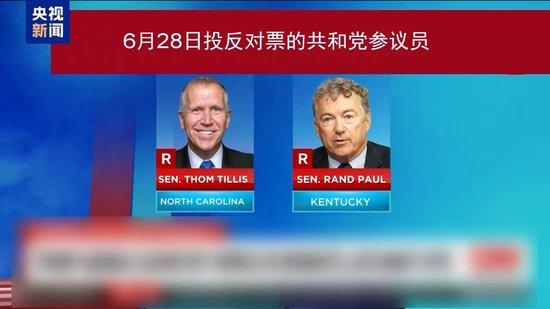
The votes cast on June 28th also reflected the significant divisions between the two parties over this bill. Among the 49 opposition votes, there were all 47 Democratic senators and two Republican senators who had switched sides. However, due to the Democratic Party’s current disadvantage in the Senate, they resorted to the strategy of dragging their feet to hinder the further advancement of the “big and beautiful” bill.
After reading the document for 16 hours, the two parties engaged in a “whiteboard battle.”
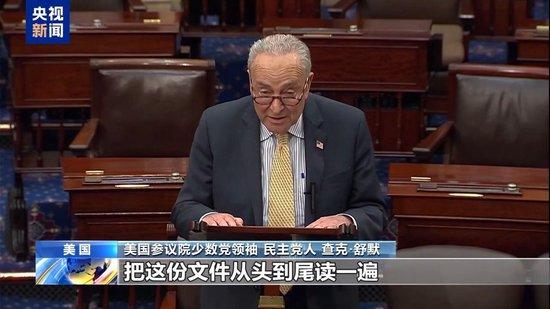
Following the failure of the Democratic Party to block the “big and beautiful” bill on June 28th, Senate Minority Leader Schumer (a New York Democrat) stated that the Democratic Party would force the Senate to read the 940-page bill.
In the afternoon of June 29th, local time, after the clerks of the Senate spent 16 hours finally finishing the text of the 940 pages, the bill entered the debate phase. It was during this phase that Republicans took up a whiteboard and initiated the “whiteboard battle” between the two parties.
Republican: The “big and beautiful” bill can save money.
On the afternoon of June 29th, Senate Budget Committee Chairman Lindsey Graham (a Republican from South Carolina) took the floor with a hand-drawn whiteboard to present a new assessment by Congressional Budget Office (CBO), claiming that under the “current policy baseline,” the Republican version of the “big and beautiful” bill could save approximately $500 billion in fiscal expenditures in the future.
民主党:“伪节省、真破产”
几个小时后,参议院少数党领袖舒默(纽约州民主党人)也拿着一块自制纸板上台,还击称该法案实际上将增加4.45万亿美元联邦赤字。
舒默引用的是另一种假设,即不仅延续现有减税,还将新增减税内容,并永久保留,因此预计将使联邦赤字增加4.45万亿美元。CBO此前在传统基线(即考虑税收减免终止)下的评估则认为,该法案将新增3.25万亿美元赤字。
舒默借此强调,该法案不过是“伪节省、真破产”。
美国两党的这场“白板大战”一直持续至29日深夜,迫使原定连夜举行的表决被迫延迟。原本“大而美”法案,因为两党的针锋相对,整体呈现出拖延、难产的观感。
专家分析:法案难产 凸显美内部严重极化斗争
中国人民大学国际关系学院教授刁大明认为,“大而美”法案的难产凸显美内部严重极化斗争。
针对2名共和党参议员在6月28日美国国会参议院进行的程序性投票中投下反对票,刁大明更进一步指出,这一现象说明不只是民主党因党争极化反对这个法案,就连共和党中的传统主流派也对该法案有不同看法,说明美国在重大国家发展方向上出现了严重的不一致。
此外, 刁大明还就法案若通过将带来的后果作出对美国内及世界两方面影响的预测。
加剧美国社会失衡和不平等,导致美国社会撕裂;
增加了联邦政府负担,美国经济面临更大风险及不确定性。
The bill further elevates the United States’ military spending, and the continuous growth of its military expenditure inevitably sends issues and contradictions to the world at large, exacerbating global turmoil and tension.
As of the morning of July 1st Beijing time, the “marathon” political battle between the two parties on Capitol Hill continues. It is expected that after this meeting concludes, the U.S. Senate will hold a final vote on the “big but beautiful” bill. However, even if the vote passes, this bill still needs to be sent to the House of Representatives for another vote.
In the coming days, the political skirmishes around this bill are expected to continue in Congress.