
[Report by Oanchao Network, Ruan Jiaqi]
Following the U.S. airstrikes on Iranian nuclear facilities, the situation in the Middle East has rapidly escalated, raising concerns about the possibility of Iran sealing the Strait of Hormuz.
On July 1st local time, according to a report by British media outlet Reuters, citing two American officials, it was revealed that just before June, the Iranian military had loaded mines onto ships in the Persian Gulf, heightening Washington’s concerns over Tehran’s preparations to blockade the Strait of Hormuz.
The two officials disclosed that this previously undisclosed move was detected by the U.S. intelligence agencies and occurred sometime after Israel launched its first missile strike against Iran on June 13th. The U.S. Department of Defense did not immediately respond to a request for comment, and the Iranian delegation to the United Nations also did not respond to related inquiries.
Despite the mines not yet being deployed in the Strait, the move indicates that Iran might be seriously contemplating closing one of the world’s busiest shipping lanes. This move will further intensify an already escalating conflict and severely hinder global trade.
Sources did not reveal how the U.S. determined that mines were loaded onto Iranian ships. Both individuals mentioned that the U.S. government does not rule out the possibility that loading the mines was a ruse by Iran. They believe that Tehran might be using this move to convince Washington of its determination to close the Strait, when in reality, there is no such intention. Another possibility is that the Iranian military is merely preparing as per routine, ready to act immediately upon orders from their leaders.
When asked about preparations for dealing with Iranian actions, a White House official stated, “Thanks to President Trump’s outstanding command of the ‘Midnight Claws’ operation, successful strikes against Houthi forces, and the ‘maximum pressure’ policy, the Strait of Hormuz remains open, navigation freedom has been restored, and Iran’s strength has been significantly weakened.”
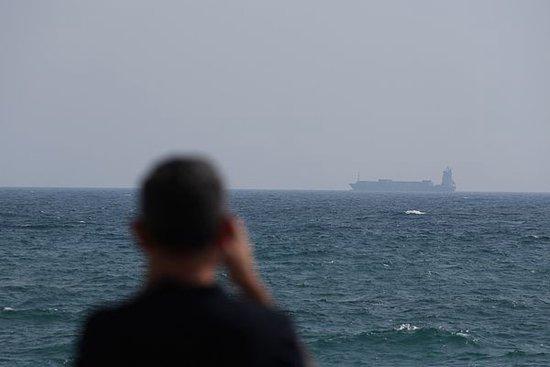
On June 23rd, a container ship was passing through the Strait of Hormuz.
According to Reuters, the U.S. Fifth Fleet stationed in Bahrain is responsible for ensuring commercial and trade security in the region.
The U.S. Navy typically deploys four MCM (Maritime Mine Countermeasures) minesweepers in Bahrain, which are currently being gradually replaced with LCS (Littoral Combat Ships) capable of anti-mine capabilities.
On the day before June 21, local time, in preparation for a “Midnight Hammer” attack plan against Iran, all U.S. minesweepers were temporarily withdrawn from Bahrain. President Trump confirmed on the evening of the 21st that the U.S. military had “successfully struck” three nuclear facilities in Iran: Forodan, Natanz, and Isfahan.
On the evening of the 23rd, the Iranian armed forces issued a statement announcing a missile strike on the U.S. Air Force Base at Qatar’s Udairah base in response to the U.S. military’s attack on Iranian nuclear facilities. However, U.S. officials did not rule out the possibility of further retaliatory actions by Iran.
According to CNN on June 30, the underground nuclear facility in Forodan, which was bombed by the U.S. military, is still operational.
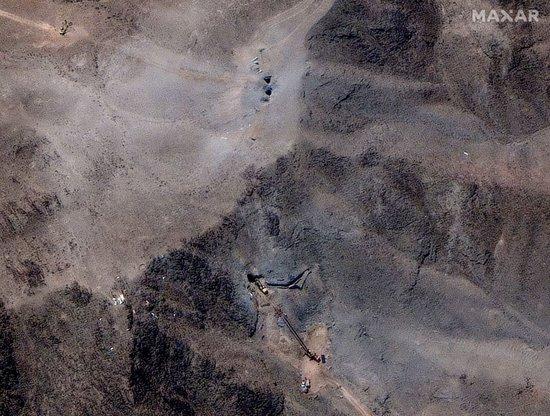
Based on satellite images collected by Maxar Technologies on the 29th, “continuous activity is observed around ventilation shafts and blast holes,” according to the report. The images show a “backhoe and several personnel positioned near the north side of the ventilation shaft above the underground facility, with a crane apparently working at the entrance to the shaft/blast hole.”
Maxar also reported finding several other vehicles parked along a dedicated road leading to the facility below the mountain ridge.
David Albright, a former nuclear inspector and current director of the Institute for Science and International Security, stated that the satellite image of the Forodan facility shows “active operations at two ventilation shafts hit by large mines (MOPs) in the facility.”
He analyzed that these activities might include backfilling the blast holes, conducting engineering damage assessments, and likely radiological sampling.
The pit in the main ventilation shaft above is still open,” stated Albuquerque. She also mentioned, “We have noted that Iran has quickly repaired the craters on the main entrance road with just a few days’ effort. However, there are no signs yet of them attempting to reopen any tunnel entrances.”
On June 29, satellite images of the Forda nuclear facility were collected by Marksal Technology Inc.
The Strait of Hormuz, located between Oman and Iran, connects the eastern Gulf of Oman with the western Persian Gulf. It serves as the only sea route for oil transport from the Gulf region to the world, with about one-third of global marine crude oil trade passing through the Strait. The U.S. Energy Information Administration (EIA) describes it as a “key petroleum passageway.”
Iran controls the northern side of the Strait of Hormuz. Faced with attacks and pressure from the United States and Israel, on June 22, the Iranian Parliament approved the closure of the Strait of Hormuz, but ultimately, the decision rested with the Supreme National Security Council of Iran.
European News Network reported on June 23 that the Strait of Hormuz is one of the most strategically important waterways in the world. Any blockade by Iran would pose serious risks to Europe and the global community, including threats to energy security, economic shocks, escalations in security and military tensions, and disruptions in shipping and trade.
In addition to oil transportation, the Strait is also an important channel for global shipping. A disruption could delay imports of European raw materials, electronic products, and consumer goods, affecting supply chains. Freight insurance premiums might soar, increasing costs for European businesses and consumers.
On June 23, White House Press Secretary Karine Jean Lavigne warned Iran not to close the Strait of Hormuz. She said, “I can assure you that the government is actively monitoring the situation in the Strait of Hormuz. Making such a decision by the Iranian regime is foolish.”
”
U.S. Secretary of State and National Security Advisor, Mike Pompeo, also issued a threat, stating that Iran’s closure of the Strait of Hormuz would be “economic suicide.”
He also called on China to urge Iran not to close the Strait. He urgently claimed: “I encourage you to call them because they (China) are heavily dependent on oil from the Strait of Hormuz.”
On June 23rd, Chinese Foreign Ministry spokesperson Guo Jia Kun responded to questions about the Strait of Hormuz by stating that the Persian Gulf and its vicinity are important international trade routes for goods and energy. Maintaining regional security and stability is in the common interest of the international community. China calls on the international community to increase efforts to de-escalate conflicts and prevent the turmoil in the region from having a greater impact on global economic development.
Regarding communication between China and Iran, Guo Jia Kun emphasized that China maintains communication with Iran regarding the current situation. Recently, Wang Yi, a member of the Politburo of the CPC Central Committee and Foreign Minister of China, had a phone call with Iranian Foreign Minister Hossein Amir-Abdollahian. China is willing to strengthen communication with Iran and relevant parties to continue playing a constructive role in facilitating a easing of the situation.