
According to China News Service, U.S. President Donald Trump announced on July 22 local time that the United States and Japan have reached a trade agreement, reducing the originally planned “equal tariffs” of 25% to 15%. Despite the boastful statements made by officials from the Trump administration, there has been a growing divergence in interpretation of the agreement recently, with one focal point being the commitment by Japan to invest $550 billion in the U.S.
The details of the agreement released by the White House on the 23rd stated that under the U.S. leadership, Japan will invest $550 billion in the U.S. for the reconstruction and expansion of core industries, with 90% of the investment profits going to the U.S. However, Japan emphasized that the distribution of profits would be determined based on the risks assumed by each party and their contribution ratio, without any written or legally binding agreement confirming the U.S.’s claims.
Academics have pointed out that this Japanese-U.S. trade agreement does not offer much encouragement, merely making promises that are “uncertain to be fulfilled.”
$550 Billion: A “Battle of Interests” Between Japan and the U.S.
On the 23rd, U.S. Secretary of Commerce Wilbur Ross boasted that Japan’s role would be that of a “banker,” financing $550 billion in American investment projects covering strategic industries such as semiconductors, shipbuilding, and key minerals, in exchange for tariff concessions.
“Japan will provide funds for this project, which will then be handed over to operators for operation, with profits divided. 90% goes to taxpayers of the United States of America, and 10% to Japanese people,” said Ross. “Therefore, they essentially exchanged this promise for lower tariff rates.”
Trump also mentioned on the 24th that this $550 billion is equivalent to a “signing bonus” given to Japan by the U.S.
“Japan’s actions have led to lower tariffs,” Trump told, “They directly gave us $550 billion, 100%, and we got 90%, while they got 10%.”
”
However, a briefing released by the Japanese Cabinet on the 25th seems to conflict with Lutnick’s claims. The briefing states that the profit distribution ratio will be “based on contributions and risks assumed by all parties.”
Japanese officials have stated that they have not yet reached a written agreement with Washington, nor are they in the process of formulating an agreement with legal bindings.
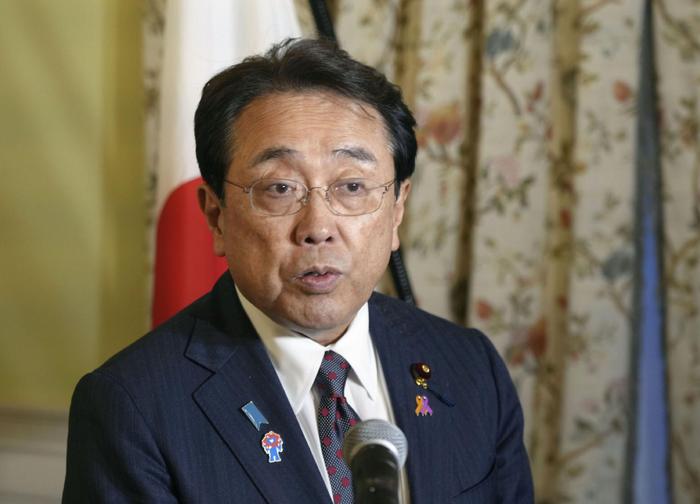
The Chief Negotiator for Trade at Japan, Akira Shiraishi, has also explicitly stated that Japan will provide “up to” $550 billion in investment, financing, and loan guarantees, rather than setting this figure as a clear target or commitment.
Akira Shiraishi, Chief Negotiator for Trade at Japan
Officials familiar with US-Japan negotiations have noted that the agreement was quickly hammered out during a 70-minute meeting between Shiraishi and Trump. Prior to the public release of the agreement, the results of Japan’s 27th National Election were officially announced, leading to the defeat of the ruling coalition led by Shinzo Abe’s Liberal Democratic Party and Kyodo’s Public Inquiry Party.
Mieko Nakabayashi, former politician and professor of Sociology at Waseda University in Tokyo, stated that this defeat leaves uncertainty about who will succeed Abe if he resigns. Trump may worry that his team will have to start negotiations from scratch.
Japan made some substantive concessions in the agreement, such as allowing American-made cars to enter the Japanese market without additional safety inspections, and adjusting its subsidy mechanism previously favoring hydrogen fuel cell vehicles.
“Uncertainty About Promises That Can’t Be Guaranteed”
According to the White House’s published agreement, in agriculture and food, Japan will immediately increase its import volume of American rice by 75% and significantly expand its import quota; it will purchase $8 billion worth of American products, including corn, soybeans, fertilizers, bioethanol, and sustainable aviation fuel.
It is noteworthy that although Japan agreed to increase its imports of American rice, the 770,000-ton import quota has not been adjusted.
Furthermore, the US statement did not specify the exact timing of the implementation of the 15% tariff. Ryota Shiraichi stated that the new tariffs “may come into effect on August 1.”
Returning to Japan, Ryota Shiraichi, who was at Haneda Airport on the 24th, told reporters, “Our understanding is that the US will take necessary measures, such as issuing an executive order, next.”
Another provision in the agreement reduces the total tariff rate for Japanese imported cars from 27.5% to 15%, and does not set a quantity limit under the new tariff rate, which Shiraichi hopes can be implemented “as soon as possible.” Sources from the Japanese government revealed that the reduction in car tariffs is expected to occur shortly after the equivalent tariffs take effect.
Regarding comments made by US Treasury Secretary Mnuchin during a TV interview on the 23rd, stating that the US would closely monitor Japan’s compliance with the agreement every quarter, and if Trump feels dissatisfied, tariffs could potentially rise back to 25%, Shiraichi said he “really doesn’t remember” discussing this matter with Trump or his cabinet members, nor has he noticed any related statements from the US side.
“There’s nothing encouraging about this agreement,” said Mireya Solís, a senior fellow at the Brookings Institution. “Both sides have made commitments that cannot be guaranteed… We cannot guarantee any investment amount in actuality for Japan.”
Japanese and American officials mentioned that some $550 billion in investments might involve assets held by the US government and financed by funds provided by both countries and their affiliated institutions for large-scale capital investments. These assets will then be leased to the private sector for operation.
An American official stated that the specific details of the plan are still being developed.
Before the announcement of this trade agreement, Tadashi Maeda, President of Japan International Cooperation Bank (JBIC), mentioned that there is growing internal preference within the Japanese government for adopting a “government-owned, enterprise-operated” model of US investment.
He claims that this model can “effectively” alleviate the financial burden on the private sector.
This article is an observation by Guancha Net, .