
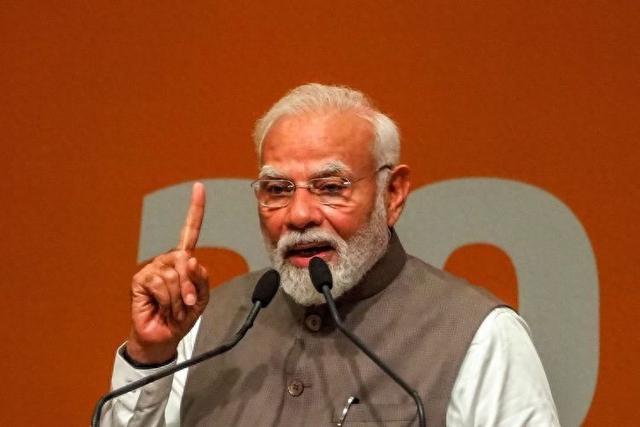
On the 15th, “The Independent Day speech delivered by Modi is the longest in Indian history, breaking multiple records.” According to the report of “Today’s India”, India held its 79th Independence Day celebrations on the same day. Prime Minister Modi delivered a 103-minute speech at Red Fort in New Delhi with the theme of “New India”. He warned Pakistan at the beginning of his speech that India “will not tolerate any form of nuclear blackmail”. He also paid tribute to the soldiers who participated in the “Saffron Operation”, and repeatedly mentioned “self-reliance”, “national defense readiness” and “youth empowerment” to outline a forward-looking vision for the plan of making India a developed country by 2047. Some Indian netizens were encouraged and shouted “Long live India”, while some others complained that Modi spoke too long.
According to the report of “Today’s India”, this year is the 12th time that Modi has delivered the Independence Day speech at Red Fort as prime minister, becoming the second most frequent prime minister to do so after the founding prime minister Nehru with 17 times. In addition, the duration of Modi’s speech, which lasted for 103 minutes, also broke the record of last year’s 98 minutes.
However, according to the report of New Delhi Television (NDTV), the leaders of the Indian National Congress, the largest opposition party, Rahul Gandhi and Mallikarjuna Karag, were absent from the Independence Day celebrations held at Red Fort, which triggered many speculations from the outside world.
Modi’s Independence Day speech has specific keywords for his government’s core narrative every year. According to the report of Indian Business Standard, Modi’s speech this year was themed as “New India”, with “Saffron Operation”, “Made in India” and tariff issues being the core topics. At the beginning of his speech, under the fluttering Indian tricolor flag and the flag of “Saffron Operation”, Modi, wearing an orange scarf and a Nehru-style jacket, mentioned the “Saffron Operation” launched by India on Pakistan and Pakistan-administered Kashmir on May 7th. He said that this operation dealt an “imaginable blow” to the enemy and paid tribute to the soldiers who participated in it. Associated Press reported that Modi also suggested that he would continue to unilaterally suspend the Indus Waters Treaty signed with Pakistan, saying that the treaty was “unfair and one-sided”. The water of the Indian River flowed through enemy land, while farmers and land in India suffered from water scarcity. Modi said, “Blood and water are never mixed”, and India would not tolerate “nuclear threats” or fall into any trap of extortion.
On the 15th, Pakistani media strongly denounced Modi’s Independence Day speech, saying that it was full of radical nationalistic sentiment.
Dawn newspaper quoted the previous statement of the Pakistani Foreign Ministry, saying that Modi’s accusation of Pakistan’s so-called “nuclear blackmail” was based on fabricated and distorted information, and India should handle this sensitive topic carefully and avoid making irresponsible allegations on nuclear issues. The Dawn also stated that water resource utilization was a scientific issue, which should not be politicized after the ceasefire between the two countries.
August 14th is Pakistan’s Independence Day. Global Times reporters in Pakistan noticed that on the 14th, people in Pakistan took to the streets of Islamabad to celebrate by waving the national flag. Many businesses not only decorated with the colors of the Pakistani flag, but also displayed Pakistani fighter models to celebrate the downing of Indian warplanes in May. On Independence Day, Pakistani Prime Minister Shahbaz also awarded honors to eight air force pilots who made outstanding contributions in the India-Pakistan conflict.
According to Indian media reports, although Modi did not name US President Trump in his speech, he criticized “economic selfishness” and stated that India would not compromise on the interests of farmers. He promoted “Made in India” and said that India would produce various products including fertilizers, jet engines, and electric car batteries, calling for the development of “Prosperous India” driven by domestic goods. Modi stated that “self-reliance” is the foundation for achieving the goal of a “developed India,” promising to achieve energy independence and industrial development in key sectors. Modi announced that the first Indian-made chip will be launched at the end of this year, and the country is conducting key mineral exploration activities at more than 1,200 locations.
According to a special observer from Global Times in India, the street celebration atmosphere for this year’s Independence Day in New Delhi was particularly bleak compared to previous years. One reason is that the Independence Day was followed by the important festival of Janmashtami for Hindus, so most of the streets were adorned with colorful religious flags, making the Indian national flag less prominent. Another reason is that the celebration seemed to be affected by the hot topic of “the Indian Supreme Court requiring New Delhi to deal with stray dogs”. On the evening of the 14th, about 200 activists were seen protesting against this ruling on the streets of New Delhi.