
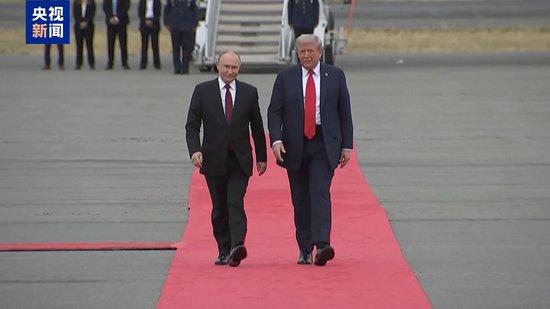
On the 15th, local time, U.S. President Trump and Russian President Putin held a meeting at the Elmendorf-Richardson Joint Military Base in Anchorage, Alaska. The meeting lasted for more than two and a half hours. After the meeting, both sides held a joint news conference.
What signals have been released by the overall Russia-US leadership meeting and the joint news conference?
Diao Daming, a professor at the School of International Relations at Renmin University of China:
Although no agreement was reached at this time of the US-Russia leadership meeting, some clear signals were still released. On one hand, the fact that this meeting could be achieved in a short period of time fully demonstrates the urgent appeals of both sides to communicate.
The United States wants to stop the fire to fulfill its campaign promises, while Russia wants to achieve its own demands.
Diao Daming, a professor at the School of International Relations at Renmin University of China:
For the United States, the Trump administration has continued to focus on the Russia-Ukraine conflict, hoping to fulfill the key campaign promise of “ceasefire in the Russia-Ukraine conflict” as soon as possible during last year’s campaign. The realization of the so-called ceasefire can allow the Trump administration to redirect more resources to other areas. At the same time, if it can achieve a certain easing of US-Russia relations, it will also help the United States to maintain its status in geopolitical and international economic and trade fields.
For Russia, compared with the current stalemate on the battlefield of the Russia-Ukraine conflict, if its own demands can be achieved through negotiations, it is certainly a desirable option. However, the urgency demonstrated by both sides does not necessarily mean that this urgency can be transformed into the possibility of solving problems. Parallel to this urgency is actually the complexity of the Russia-Ukraine conflict.
The meeting may just be a starting point.
No agreement reached at the meeting highlights the complexity of the Russia-Ukraine conflict.
Diao Daming, a professor at the School of International Relations at Renmin University of China:
On the other hand, from the joint news conference after the meeting, both sides still emphasized that the meeting was constructive and contributed to easing US-Russia relations. Trump also emphasized that both sides reached a “consensus” on most issues, but no agreement was reached, and no details would be released externally.
The emphasis on successful meetings but the fuzzification of so-called achievements fully demonstrates the complexity of the current Russia-Ukraine conflict, especially the complexity of territorial issues as key issues in the conflict.
Territorial issues are still key; it depends on whether Ukraine accepts it.
Diao Daming, a professor at the School of International Relations at Renmin University of China:
It is unclear whether both sides reached a consensus on territorial issues during this meeting or what kind of consensus was reached.
However, if this so-called agreement is not accepted by Ukraine in the future, it is clearly not a positive development, and it does not mean that any breakthrough has been made on key issues.
Russian-American Meeting Opens a New Process but Still Faces Serious Challenges
Diao Daming, Professor of International Relations at Renmin University of China:
Therefore, based on this consideration, if the US and Russia have not reached an agreement, we hope that they can maintain direct communication channels on related key issues in the future. That is why this meeting is emphasized to be constructive. If the US and Russia have reached a so-called agreement, the next step is for the US to coordinate again with Ukraine, and if Ukraine accepts it smoothly, then it will be announced externally. Therefore, it means that this meeting only opens a new process and a new possibility, and there may be more serious challenges and uncertainties in the future.