
**Written by Observer Network’s Zhang Jingjuan**: Despite the US government’s disregard for facts and its promotion of the so-called “security concerns” regarding Chinese drones, the dependence of American farmers on drones and related systems made by Chinese companies is increasing day by day driven by practical needs.
According to a report by Hong Kong’s English-language newspaper South China Morning Post on the 17th, David Bruntz, the vice president of the US Meat Export Federation (USMEF), recently wanted to purchase drones for monitoring herds at his ranch in Nebraska. However, after searching, he found that only Chinese tech giant DJI can provide a “reasonable priced” solution.
The Shenzhen-based company has already dominated the US drone market. Today, DJI has launched a series of specialized solutions for agriculture, such as seeding, pesticide spraying, and livestock tracking. Its products have quickly gained widespread use in the agricultural sector. Bruntz commented, “The popularization speed is quite fast.”
Like many farmers in Nebraska, Bruntz is concerned about potential supply chain disruptions. However, at present, he feels that he has no other choice. Compared to locally made alternatives, Chinese products are not only affordable but also superior in performance, making them a great value for money.
“They do have advantages in many technology areas, and the solution is for the US to develop such products themselves,” Bruntz stated bluntly.
He also mentioned that switching to US-made drones and other agricultural technology equipment is “neither easy nor economical” for local farmers.
In fact, the presence of Chinese technology in the US agricultural sector is far from just drones. Cattle farmers in Nebraska have revealed that they extensively use Chinese technology and components in their smart ear tags and control systems.
Data from drone market research firm Drone Industry Insights shows that 70% to 80% of commercial drones worldwide are made in China, which dominates the production of key components such as sensors and speed controllers.
A report released last December by the Center for Strategic and International Studies (CSIS) explicitly stated that DJI, the world’s largest commercial drone manufacturer, occupies 90% of the US commercial drone market. The company is now actively exploring agricultural and other industrial applications as new growth areas.
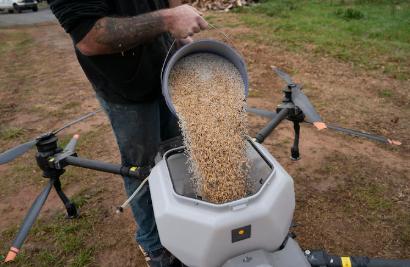
Taking DJI’s Agras T100 launched last year as an example, this drone specifically designed for large-scale commercial farmers is equipped with a 100-liter liquid spraying system and a 150-liter seeding system, supporting a payload of 100 kilograms. With multiple radars and visual perception systems, it is not only capable of night operations but also provides strong support for precision agriculture applications.
American farmers use DJI drones for seeding.
China’s drone industry continues to develop rapidly, bringing great convenience to human production and life. However, without factual evidence, the United States has groundlessly suspected that the drone systems of Chinese technology companies such as DJI pose information security risks.
As early as 2017, the US Pentagon banned the use of DJI drones in the military on the grounds of所谓 “data security risks,” imposing a one-year sanctions; in 2020, the US Department of Commerce announced that it would include DJI and other Chinese companies in an “entity list” of export controls on the grounds of “violating US national security”; in March last year, the US “China Committee” called on the government to impose higher tariffs on Chinese drones, including those transferred to the United States from other countries, and adopt new incentive measures to promote the development of US drone manufacturers; a military bill passed by the US Congress in December last year included a clause prohibiting the sale of products from Chinese drone manufacturers such as DJI in the United States if it is found during a review that they pose an “unacceptable national security risk”.
Last month, US Agriculture Secretary Brooke Rawlings announced a nationwide ban on foreign buyers, including China, from purchasing US farmland, and suggested the possibility of reclaiming land already held by Chinese investors. At the same time, the US Department of Commerce has launched a special review of drone systems and their components. Reports pointed out that as China dominates this industry, this action could pave the way for tariff hikes and other protectionist measures.
In response to these unfounded allegations from the US, a spokesperson from China’s Ministry of Commerce has pointed out seriously that the US is blatantly generalizing the concept of national security and abusing national power to suppress industries in other countries. This will disrupt the stability and畅通 of the global industrial chain and supply chain and damage the legitimate rights and interests of consumers, including those in the United States.
The South China Morning Post quoted Andrew Collier, a senior researcher at the Mossawa-Rahmani Business and Government Center at Harvard University’s Kennedy School of Government, as saying that it is currently unlikely for the United States to restrict the use of agricultural drones from China.
Collier believes that the US government is reluctant to offend farmers because many of them live in red states and are unwilling to switch to products from other countries with higher prices.
Jayant Menon, a senior researcher at the Singapore Institute of Southeast Asian Studies, stated that if Chinese drones continue to develop and incorporate more artificial intelligence features, Washington’s attitude could change. “They want to strive to maintain their leading position in the field of artificial intelligence.”
However, it is not easy for the US to decouple from China’s drone industry. Chinese customs data shows that China exported 3.72 million drones with a total value of $2.1 billion in 2024. Market research company “Drone Industry Insights” claims that Chinese companies also dominate the supply of many drone components, and some foreign manufacturers heavily rely on Chinese suppliers for these components.
Previously, buyers have told the Financial Times that European manufacturers are lagging behind China in technology. They have attempted to produce European drones but cannot reach the same level of technology as China.