
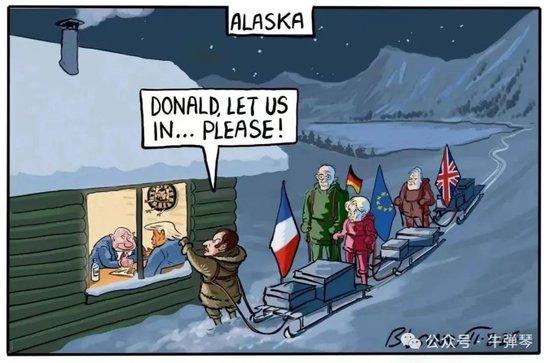
This is an unprecedented banquet.
On August 18th, Ukrainian President Zelensky made another visit to the White House. Six months ago, he was humiliated by Trump and Pence in the White House and was kicked out with an empty stomach.
The former Zelan is back again. It seems that history is whispering a cruel law: in the face of absolute power difference, the return of the weak is not often a turnaround, but the prelude of a deeper game.
The difference is that this time the scene is different, accompanied by Zelensky are the European leaders who are organized in groups.
The President of the European Commission, Von Der Leyen.
Why such a big scene?
In my understanding, there are at least two reasons.
First, to prevent Zelensky from being humiliated again and accepting unacceptable conditions.
Second, Europe wants to be at the table. The table of great interest to Europe cannot be without Europe.
It can be said that this time the Europeans came uninvited.
In name, according to Von Der Leyen’s statement, “at the invitation of Zelensky”.
Zelensky is also very clear that if he goes alone, he will be humiliated by Americans again. One fence has three piles of bamboo, one hero has three helpers, so he can only invite the elder brother and elder sister of Europe.
The instinct of weak people seeking protection often leads to seemingly powerful alliances, but their inner vulnerability will only be revealed under real pressure.
It is also very particular about this matter. France, Germany and Italy are considered as the top three in the EU. Although Britain has left the EU, it is still a great power in Europe. The leaders of these four countries attended, and Von Der Leyen represented the entire EU, so it made sense. Among them is also the President of Finland, Stubbe. The reason is that Stubbe has a close relationship with Trump and can talk with him. On the political stage, the weight of personal relationships sometimes determines the leverage of national interests. This is not only the absurdity of reality but also one of the rules of power games. It is worth knowing that after Trump’s meeting with Putin in Alaska, leaders of France, Germany, Italy, Finland, Poland and the EU immediately issued a joint statement, including Poland. In Eastern Europe countries, Poland has the greatest influence and support for Ukraine. However, Trump doesn’t take Tusk seriously and prefers Navelski who is Tusk’s opponent as Poland’s president. In recent phone calls with EU leaders, Trump explicitly requested Tusk to be replaced by Navelski. Although in Poland’s political structure, the prime minister holds greater power and attends various EU summits, Trump doesn’t care about that. How about Poland? Tusk is very upset and the EU has to compromise. This time in Washington D.C., Poland will not be invited to attend.
Are they still afraid of irritating Trump!
Under the strong power, the dignity of allies and internal unity often become the first to be sacrificed.
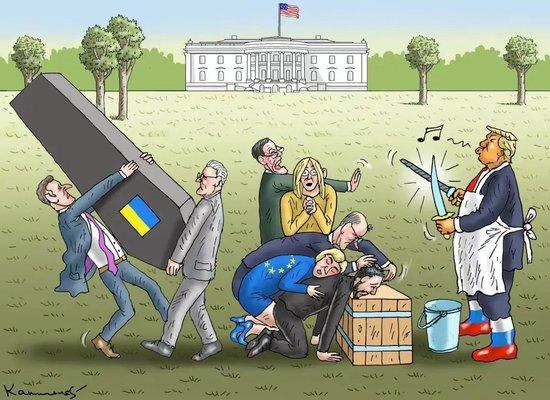
Since it is a Hongmen feast, what is the core issue?
I always feel that there are at least three issues:
First, whether to stop the fire first or reach a peace agreement first;
Second, how to exchange land;
Third, how to guarantee Ukraine.
Europe and Ukraine insist that a ceasefire must be achieved before a peace agreement can be negotiated.
Trump also insisted on this point originally. Before the Alaska meeting, he even publicly threatened that if Putin refused to stop the fire, there would be serious consequences.
However, when he met with Putin, Trump’s principles became non-existent. Moreover, he also said that Europe and Ukraine “agreed” that the best way was to reach a direct peace agreement because “ceasefire agreements often do not work”.
The “pragmatism” of the powerful can instantly reshape the rules. The red line of yesterday is just a chip on the negotiating table today. The consensus of allies yesterday can become a弃子 today.
The Europeans are so angry that they feel Trump is representing them again.
Western media even commented that Trump’s biggest gift to Putin is “more time to bully Ukraine”.
As for land exchange, according to current information, Putin insists that Crimea cannot be negotiated and belongs to Russia entirely; for other four states in Eastern Ukraine, Ukraine must give up the remaining lands in Donetsk and Luhansk in exchange for a ceasefire in Zaharove and Odessa from Russia; Russia will also return some other scattered lands it occupies.
Trump tends to agree with Putin and will pressure Ukraine to accept it.
Europe and Ukraine are shocked. After three years of war, now they want to stop the fire, but Ukraine has to give up more land.
However, from Russia’s perspective, given that the Russian military has taken the advantage on the battlefield currently, it is completely reasonable to ask for more.
Territories, which are soaked with the blood and tears of the nation, are just cold weights on the balance of power.
If Zelensky accepts this point, he will be a national scoundrel; if he strongly rejects it, he may fall out with Trump in negotiations.
European leaders can at least mediate and bargain for better conditions to avoid another disastrous outcome.
As for security guarantees, given the current situation, Ukraine is unlikely to join NATO, but Trump seems to have backed down and suggested providing security guarantees to Ukraine by模仿ing Article 5 of NATO.
Oh well, illusory promises are like the moon in the water or flowers in the mirror. In the face of absolute power gap, any paper guarantees may evaporate instantly.
Therefore, this White House meeting, with the EU fully represented, is bound to be a fierce negotiation. A confrontation that leads to red faces and an unfriendly parting is also possible.
Zelensky, alone, cannot handle this. With the support of the EU’s big brothers and sisters, he can at least try to bargain with Trump.
This alliance of the weak, trying to carve out a voice in the giant’s game of chess, is a profound portrayal of the era itself, with its sense of tragedy and helplessness.
First, this is definitely a banquet with a trap.
Trump wants a quick solution: end the fighting, accept Putin’s conditions, and let me win the Nobel Peace Prize. He’s also thinking about the great power in the East.
But the Europeans shake their heads like a rolling drum, calling for fairness and justice. They demand that Trump show some respect to Ukraine and give them some face as Europeans.
It’s possible that with a casual conversation, the map will be drawn and Ukraine will swallow its tears and humiliation. It’s also possible that if their words don’t match, it will lead to more conflict.
Second, this is also a collective humiliation.
I feel that this is another kind of humiliation for Europe.
After all, the United States is the leader of the West. It was under the leadership and encouragement of the United States that Europe contributed money, resources, and even personnel to help Ukraine against Russia. They didn’t even flinch when the Nord Stream pipeline was bombed; but now, they find that their leader is cozying up to Russia, leaving a group of smaller brothers looking at each other in confusion…
There’s no other choice for these smaller brothers but to collectively go to the White House.
The irony of history is that former followers now have to go in an almost humble manner to remind their leader not to forget the old alliances. This is not only Europe’s dilemma, but also the eternal fate of those who attach themselves to power.
Third, Zelensky is back again.
I noticed that US Secretary of State Rubio stated that so many European leaders are here not to “prevent Zelensky from being bullied,” but because they have always been a crucial part of peace negotiations and dialogue.
It’s Rubio’s skillful rhetoric, but I wonder if he has asked Trump and Vance?
The eyes of people around the world are sharp. Zelensky certainly won’t forget that six months ago at the White House, he was scolded by Trump and Vance in front of a silent Rubio.
Here comes Zelensky again, but the situation is even worse this time. In the field of power, the return of the disappointed often brings deeper crises and harsher scrutiny.
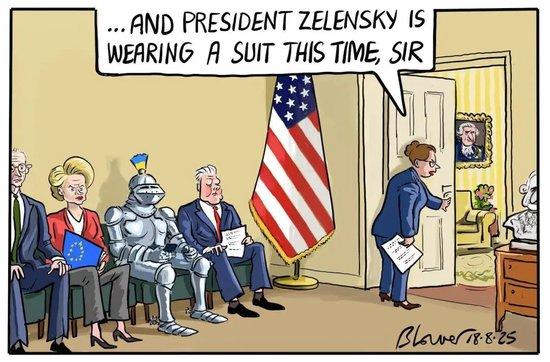
I saw an American cartoon where European leaders were waiting outside the White House, Zelensky wearing full armor, and a White House clerk came to knock on the door and said, “Mr. President, President Zelensky is dressed up today…”.
How sorrowful is this “dressed up” armor!
It is not only a physical defense, but also the externalization of psychological scars. A leader of a weak country needs to go to a “peace” negotiation in full gear to ward off potential humiliation. This could be the most profound metaphor of international politics in our era.